China’s Sea Drones: Giant UUVs, Minelayers, Seabed Mapping
China’s unmanned maritime systems: parade XLUUVs, the AJX002 minelayer, a Shanghai UUV mothership, Zhu Hai Yun and gliders, with unverified claims flagged.
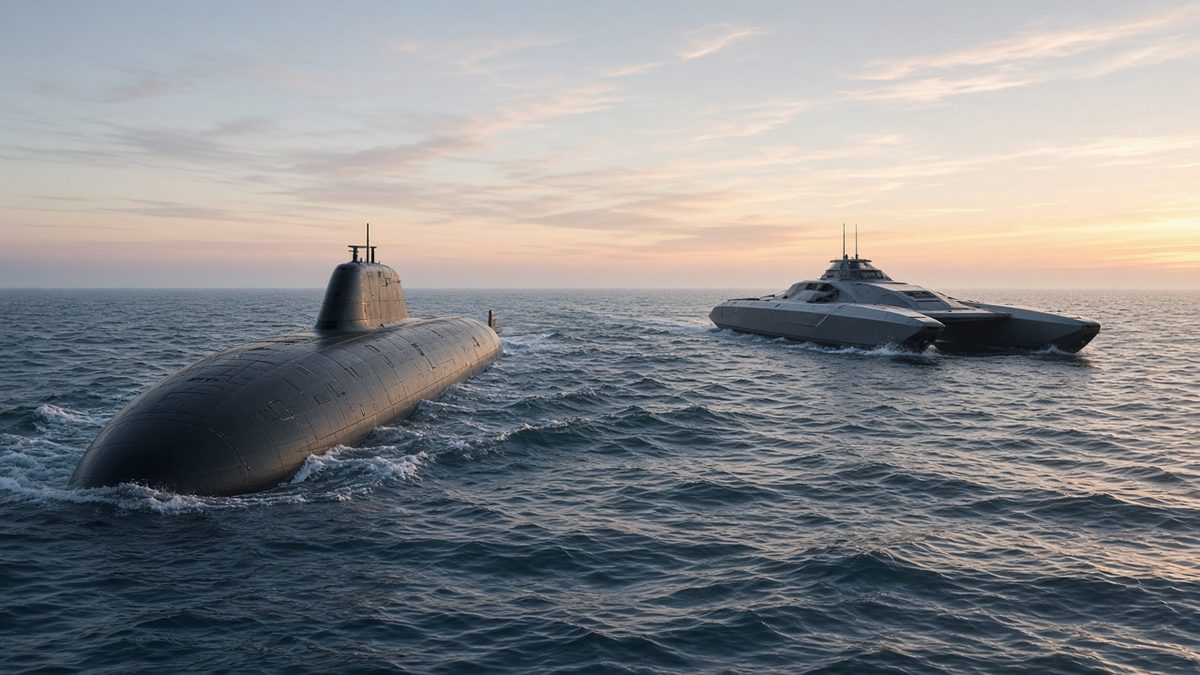
China’s unmanned maritime programme is hard to see and easy to overstate. The public evidence is a few vehicles driven through Beijing in September 2025, satellite photos of a new ship in Shanghai and research-vessel tracking. This report, current to 3 October 2026, separates what analysts have observed from what Chinese officials or state media claim, and explains why the Taiwan Strait and South China Sea are the focus.
At a glance
- Parade XLUUVs: the HSU100 and AJX002 led the unmanned naval column on 3 September 2025; commentary called the AJX002 a mine-laying system (Naval News).
- New mothership: a 204-metre ship at Shanghai’s Hudong-Zhonghua yard appears designed to carry large UUVs (The War Zone).
- Seabed mapping: Reuters traced 42 research vessels and hundreds of sensors; U.S. naval intelligence calls it a strategic concern.
Parade XLUUVs: the HSU100 and AJX002
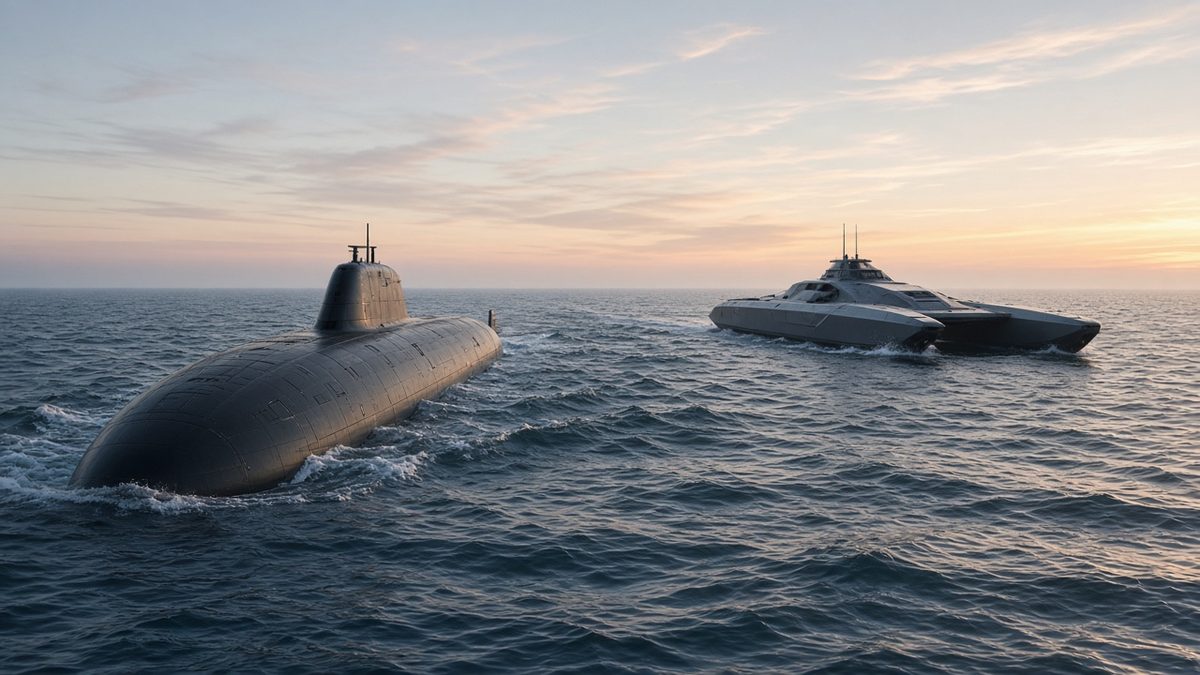
Asian Military Review reported that the HSU100 extra-large unmanned underwater vehicle (XLUUV) led the naval drone column, fitted with retractable sensors likely meant for surveillance and estimated at perhaps 15 metres. The AJX002 followed: equally long, thinner and with no visible sensors (Asian Military Review). Thomas Lim of Singapore’s RSIS told the outlet the vehicles were “too bulky not to carry some form of kinetic power”, whether torpedoes, mines or other payloads, and could help overcome coastal defences from the Taiwan Strait to the South China Sea. The parade also showed an AQS003A autonomous mine that commentary said can classify and engage targets on its own, a claim not independently tested.
Naval analyst H I Sutton, writing for Naval News, put the AJX002 at around 20 metres with an estimated range above 1,000 nautical miles, an inference from its battery space rather than a published figure. He judged it a carrier for a deep-water mine rather than a hunter, since it shows only a small obstacle-avoidance sonar and looks clumsy in confined water. Parade commentary said the unmanned systems on show “feature covert emplacement for blockade” (Naval News). Sutton adds that China has other XLUUVs, including what he believes is a full-sized uncrewed submarine; that is his assessment, not a confirmed programme.
| System | What sources say | Status / caveat |
|---|---|---|
| HSU100 XLUUV | About 15 m, retractable sensors, ISR role likely (AMR) | Parade display; deployment unknown |
| AJX002 XLUUV | About 20 m minelayer; range above 1,000 nm estimated (Naval News) | Role from official commentary; range is an estimate |
| AQS003A mine | Said to classify and engage targets on its own | State commentary, untested publicly |
| Shanghai UUV mothership | 204 m, well deck, cradle platform (TWZ) | Under construction; purpose inferred |
| Zhu Hai Yun | Mothership for 50+ aerial, surface and undersea drones (CSIS) | Officially civilian research ship |
| Haiyi gliders | 12 gliders logged 550 days at sea in 2019-20 (Janes) | Maker’s claim; science mission |
The mothership and the research-ship model
The newest evidence is a ship. The War Zone published a 10 September 2026 satellite image of a vessel about 204 metres long and 30 metres wide at Hudong-Zhonghua in Shanghai, under construction since at least April and now painted grey, which points to PLA Navy service. The image confirms a well deck and a roughly 50-metre cradle platform; Sutton reads the design as hangars for several large UUVs launched one at a time. The War Zone cautions that questions remain over its full purpose (The War Zone). Sutton says two even larger prototypes are being tested on Hainan.
A civilian precedent is the Zhu Hai Yun, a roughly 89-metre ship that CSIS says is designed to launch more than 50 aerial, surface and underwater vehicles and survey a zone 160 km across, 4,000 m up and 1,500 m down. Chinese sources call it purely scientific, but CSIS found close ties to the PLA and shipyards linked to naval construction. It circled Taiwan in late 2023 on a route CSIS judged intended to probe the island, though the “true purpose remains unknown” (CSIS). CSIS names USV maker Yunzhou Tech as a design partner. This report found little open detail on armed surface drones beyond parade commentary.
Gliders, sensors and seabed mapping
The quieter layer is data. Deepfar, maker of the Haiyi (“Sea Wing”) glider, said 12 second-generation gliders deployed from the research ship Xiang Yang Hong 06 in December 2019 completed 550 cumulative days, travelled over 6,479 nautical miles and logged more than 3,400 profiles in the Indian Ocean (Janes).
Reuters has since shown the scale of the wider effort. Tracking 42 research vessels, it found mapping near Taiwan, Guam, Hawaii and east of the Philippines, and reported hundreds of sensors and buoys in the Pacific and Indian oceans. Nine naval experts told Reuters the work has a military use, while Ocean University of China described its ship’s work as mud surveys and climate research. Rear Adm. Mike Brookes of the Office of Naval Intelligence testified that China’s surveys enable “submarine navigation, concealment, and positioning of seabed sensors or weapons.” Reuters also reports sensors in a strait between Taiwan and the Philippines that U.S. submarines would use (Reuters). Some experts doubted claims of real-time data.
Why it matters
Analysis: the picture is of mass and persistence rather than a single wonder weapon. Minelaying drones raise the odds of a covert, deniable blockade of Taiwan; a mothership lets such vehicles operate far from China; and a mapped, sensor-filled ocean helps Chinese submarines hide and find others. Each piece has an innocent label, which is why intent is hard to prove.
Counterweight: the parade vehicles are not shown in service, Sutton calls the AJX002 unagile, and the sources I opened say little about endurance, reliability or survivability. U.S. submarine strength matters here too; see our report on the Columbia-class submarine and the PrSM anti-ship role.
What to watch: the Shanghai ship’s launch, XLUUVs at sea, and more mapping near Taiwan and Guam. Daily PLA activity is tracked in our Taiwan and China news hub.
Takeaway: China is assembling a layered unmanned undersea toolkit, but what is proven is the mapping, not the combat drones.
Related coverage
- Taiwan and China news hub
- Columbia-Class Submarine: 2028 Delivery, Cost and Deterrence
- PrSM Missile: $1.2B Army Order, Iran Debut and Pacific Role
- Series: China’s air drones and China’s ground robots
Sources
- Asian Military Review, China rolls out new unmanned underwater systems in parade, 4 September 2025.
- Naval News, China’s New Giant Underwater Drone Increases Naval Mine Threat Around Taiwan, 18 September 2025.
- The War Zone, China Appears To Be Building A Mothership For Large Uncrewed Submarines, 24 September 2026.
- CSIS, Skirting the Shores: China’s New High-Tech Research Ship Probes the Waters around Taiwan, 26 February 2024.
- Reuters, China is mapping the ocean floor as it prepares for submarine warfare with the US, 24 March 2026.
- Janes, China’s latest Haiyi underwater gliders complete Indian Ocean deployment, 23 March 2020.