China’s Ground Robots: Armed Robot Dogs, UGVs and Unitree
China’s ground robots: rifle-armed robot dogs in PLA drills, wheeled logistics UGVs, Taiwan landing roles and the Unitree dual-use row, with claims flagged.
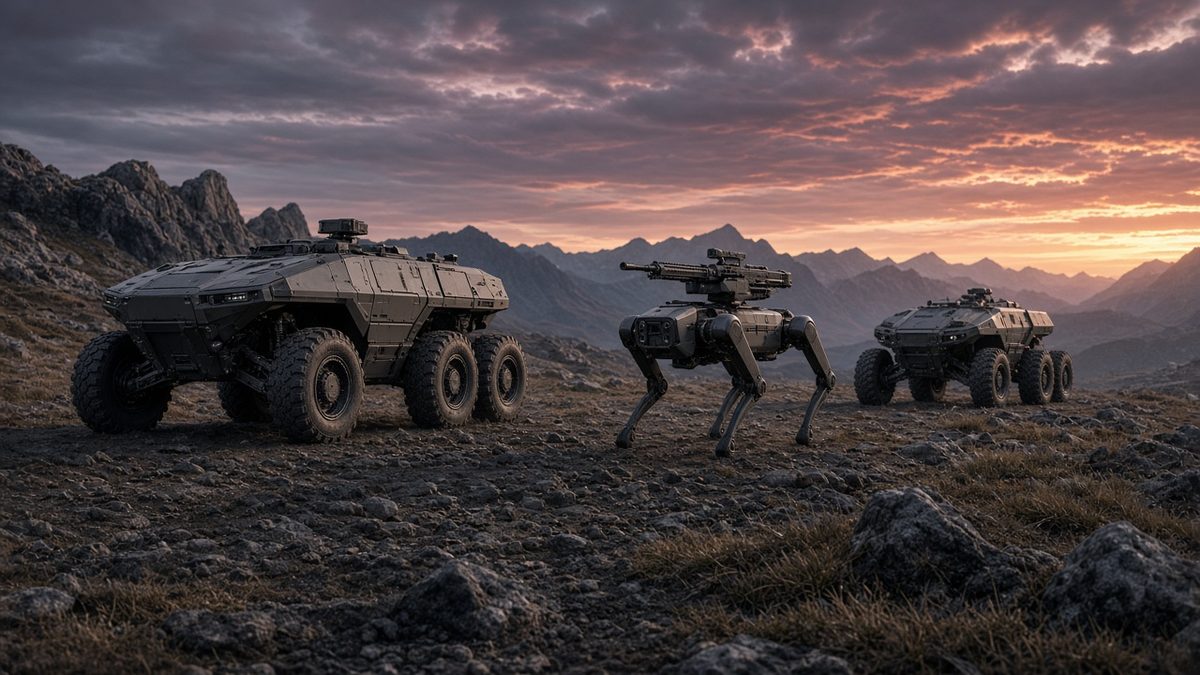
The most striking image of China’s unmanned ground force is a four-legged robot with a rifle on its back leading soldiers into a mock building. It is real footage from Chinese state television, but it does not show a fielded killer robot. What it shows is a military testing commercial robotics at the squad level, and a U.S. government now treating the robot dog maker behind some of those machines as a defence-linked company. This report, current to 3 October 2026, sets out what is documented, what is Chinese or think-tank claim, and why the Taiwan Strait is the scenario analysts keep returning to.
At a glance
- Armed robot dogs have appeared in PLA drills since at least 2023, including with Cambodia, under remote control (CNN).
- Unitree was added to the Pentagon’s Chinese-military-company list in June 2026; it says its robots are civilian (Reuters via Defense News).
- Limits: battery life, jamming and human approval for lethal force remain constraints, per FDD’s reading of Chinese sources.
Robot dogs in PLA drills
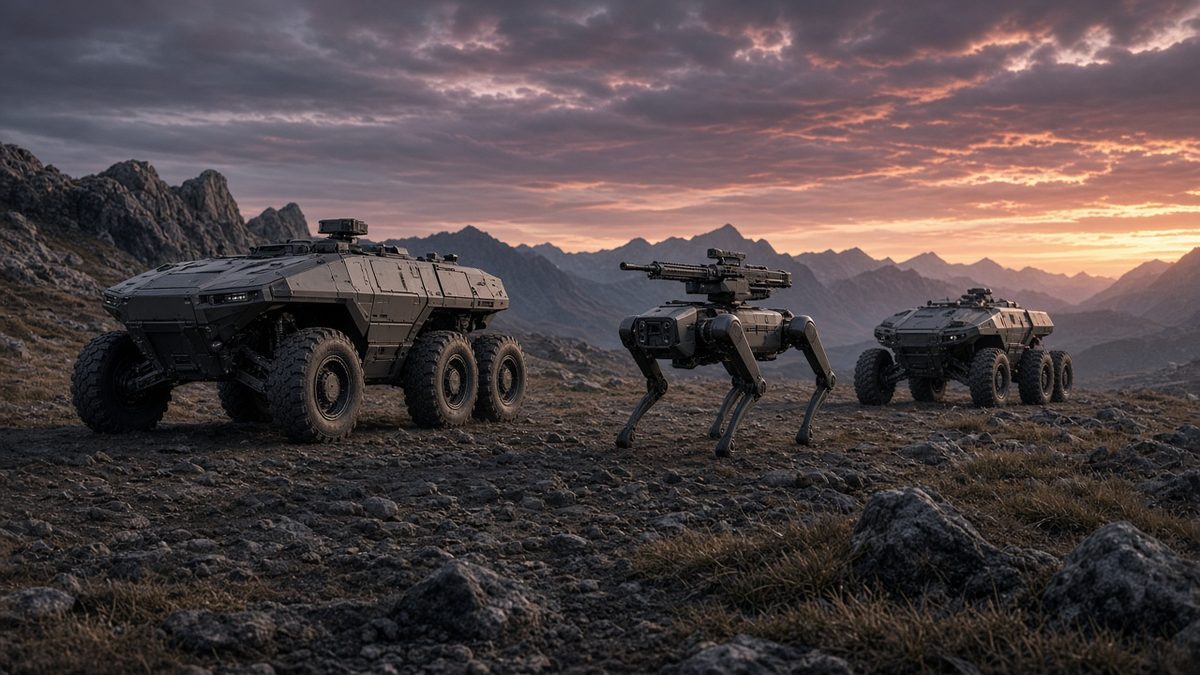
CNN reported in May 2024 that Chinese state broadcaster CCTV showed a robot dog with an automatic rifle during the “Golden Dragon 2024” exercise with Cambodia. A remote operator controlled it as it led an infantry unit into a simulated building. A soldier on the video said it could replace human members in urban combat to scout, identify the enemy and strike. CNN also noted an earlier CCTV video of rifle-armed dogs from a November 2023 exercise involving six countries, and quoted Global Times saying such equipment is not brought to joint drills unless it has reached “a certain level of technical maturity” (CNN).
A May 2026 memo by the Foundation for Defense of Democracies (FDD), a Washington think tank, argues the PLA calls these machines “robotic wolves” and is testing LiDAR-equipped versions to scout ahead of infantry, breach obstacles and carry supplies. Chinese reporting cited by FDD claims about two hours of operation, roughly 10 km range, a payload near 20 kg and survival after 30 minutes submerged. Those are claims from Chinese reports, not tested figures. FDD also describes a “three-three” assault pattern, with two wolves forward and one in reserve (FDD).
Wheeled and tracked ground vehicles
Dogs are the headline, but larger vehicles matter for logistics. The 3 September 2025 parade showed wheeled, tracked and quadruped robots, which an Army War College analysis said build on manned-unmanned teaming and can carry payloads for reconnaissance, mine clearance and fire support (US Army War College SSI). On the export side, Norinco showed its CS/VP16B at IDEX 2025: a 6×6 light unmanned vehicle with a 2,400 kg combat weight, 1,000 kg payload, autonomous or remote driving, a 2 km control range and 200 km hybrid range, pitched for supply, medical evacuation and reconnaissance (Army Recognition). These are manufacturer specifications.
| System | What is documented | Caveat |
|---|---|---|
| Rifle-armed robot dog | Shown in drills with Cambodia, remote-controlled (CNN) | Demonstration, not proof of fielding |
| “Robot wolf” quadrupeds | LiDAR, EO/IR, resupply and breaching roles in PLA training footage (FDD) | Performance figures come from Chinese reporting |
| Parade wheeled/tracked UGVs | Reconnaissance, mine clearance, fire support (SSI) | Parade display; unit service unclear |
| Norinco CS/VP16B 6×6 | 1,000 kg payload, 200 km range (Army Recognition) | Maker specifications |
| Unitree Go2 / B-series | Commercial dogs; one modified B1 shown firing a rifle on state TV (Reuters) | Unitree says products are for civilian use |
Unitree and the dual-use problem
Unitree is the centre of the policy fight. Reuters reported that its $1,600 Go2 helped it dominate quadruped robots, that company filings show it sold more than 5,500 humanoids and 18,000 quadrupeds last year, and that it was valued at about $9 billion ahead of a Shanghai listing. In June 2026 the Pentagon added it to its list of Chinese military companies as a “contributor to the Chinese defense industrial base”, a step Reuters says falls short of a sanction but limits future U.S. military use. Unitree says its robots are civilian and signed a 2022 pledge not to weaponise robots, yet Chinese state television has shown Go2 units with troops and a modified B1 firing a mounted assault rifle (Defense News/Reuters).
Reuters also found that Unitree’s designs draw on U.S. Army-funded research, which was published openly, and it reports that the FCC in July banned imports of future foreign-made humanoid and quadruped robot models. China threatened to retaliate. FDD adds that public tenders show military and paramilitary police institutions seeking robot-dog support services through firms including Unitree, and notes that Chinese firms hold nearly 80 percent of global LiDAR sales.
Why it matters
FDD argues Taiwan is the most plausible proving ground: Chinese state video shows robot wolves leading simulated beach assaults, absorbing early fire so infantry can get ashore, and fighting in mock towns beside drones. Its authors, Craig Singleton and Jack Burnham, say machines could redistribute risk and lower the political cost of early casualties, which might change Beijing’s calculations. In a June interview with Taiwan’s Central News Agency, Singleton urged Taiwan to build layered, cheap defences: detection, jamming, navigation disruption and counter-robot urban drills (Focus Taiwan). The same piece notes that Taiwan’s National Chung-Shan Institute of Science and Technology showed three military robot dog prototypes in June.
Analysis: the evidence supports a modest conclusion. The PLA is experimenting seriously and borrowing from a commercial base that is cheaper and larger than anything the U.S. has. But FDD itself says current policy keeps the systems semi-autonomous, that a PLA Marine brigade commander said humans must approve lethal force, and that radio links, satellite navigation, batteries and light weapons fire are weak points. A robot that depends on a charging truck is not yet an assault force. For the U.S. side of the drone-era land fight, see our report on the M1E3 Abrams.
What to watch: Unitree’s responses to the Pentagon listing and the FCC ban, any PLA unit publicly equipped with robots, and Chinese retaliation. Broader context sits in our Taiwan and China news hub.
Takeaway: China’s ground robots are real, cheap and being tested in Taiwan-style scenarios, but verified combat capability lags the footage.
Related coverage
- Taiwan and China news hub
- M1E3 Abrams: Lighter, Three-Man Tank Heads to Soldier Tests
- China’s Purge of Zhang Youxia and Liu Zhenli Clouds PLA Readiness
- Series: China’s air drones and China’s sea drones
Sources
- CNN, China’s military shows off rifle-toting robot dogs, 28 May 2024.
- Foundation for Defense of Democracies, China’s War Wolves: From Commercial Tech to Combat Power, 3 May 2026.
- Reuters via Defense News, How US military funding propelled China’s robot dogs, 18 August 2026.
- US Army War College SSI, China’s September 2025 Military Parade, 5 September 2025.
- Army Recognition, China expands its Lynx family with the new CS/VP16B, 19 February 2025.
- Focus Taiwan (CNA), Taiwan needs layered defenses against China’s ’robot wolves’, 16 June 2026.