Russia’s Ground Robots: Logistics Workhorses, Few Killers
Russia’s ground robots mostly haul supplies, not fight. What sources say about Kuryer, Uran-9, Marker and Centre-2026, and how Ukraine’s UGV use compares.
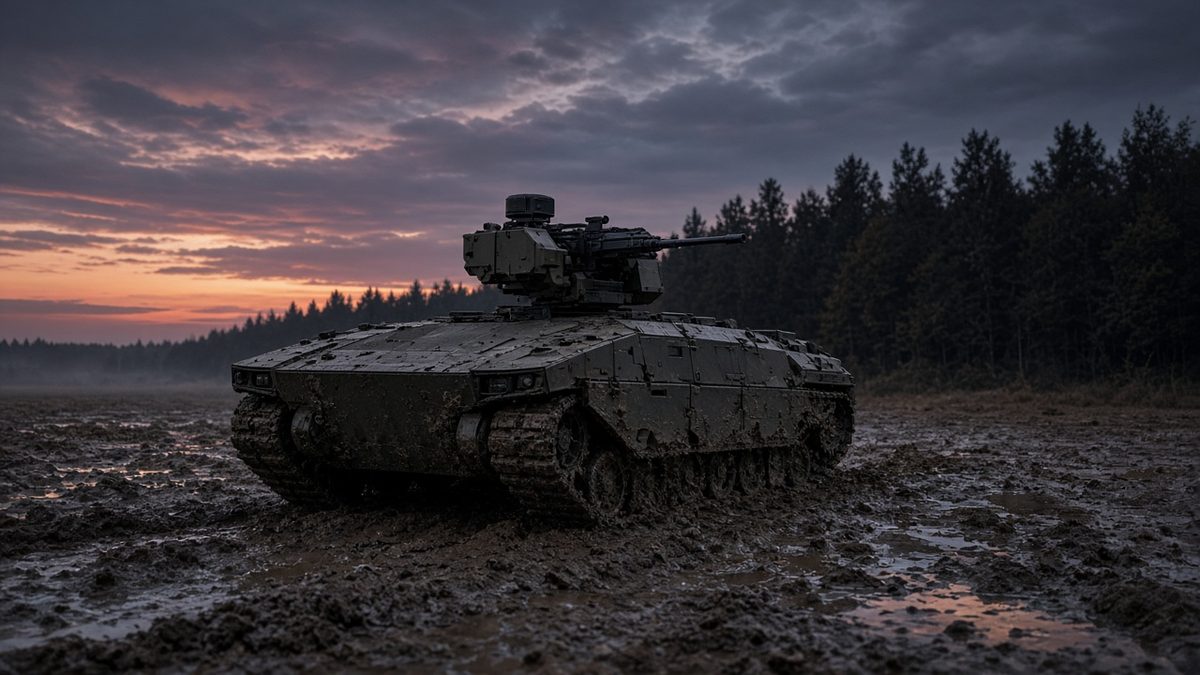
Russia spent years showing off armed robot vehicles at exhibitions, yet the machines doing real work at the front in 2026 are small, cheap and mostly unarmed. Analysts and Ukrainian commanders say the dominant use is hauling ammunition and evacuating wounded under drone fire, not assaulting trenches. At the same time, Russia’s Centre-2026 exercise this week showed unmanned tanks again. This report separates what is fielded from what is demonstrated.
At a glance
- Fielded: a Kyiv think tank, StateWatch, identified 32 Russian ground-robot models, at least 20 used in combat; the Kuryer, Varan and Impulse-M are in serial production (HiWars).
- Role: a Ukrainian regiment commander told Militarnyi that 80 to 90 percent of robots on both sides mainly carry supplies (Militarnyi).
- Scale gap: Ukraine logged 25,143 UGV logistics and evacuation missions in August alone (Ukraine’s Defense Ministry).
What Russia actually fields
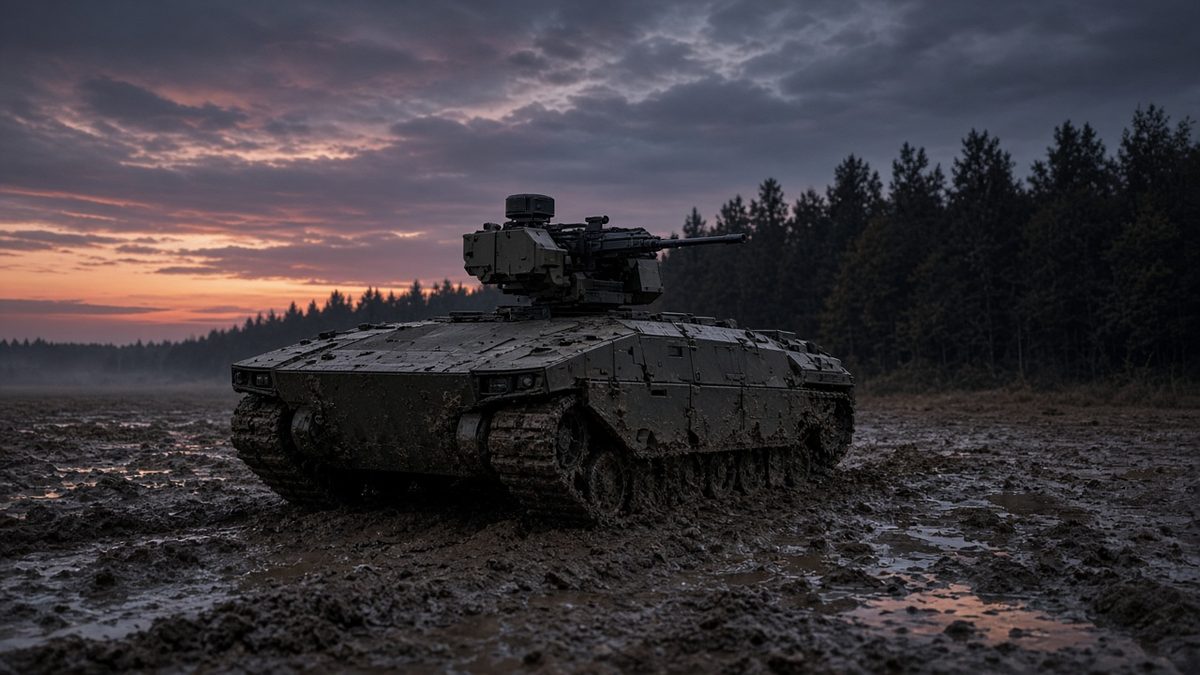
The StateWatch report, summarized by HiWars, describes a sector that barely existed in 2022. The tracked Kuryer (Courier) is the most widely deployed model, with a claimed 200 kg payload, speeds up to 35 km/h and a control range of 3 to 10 km. It began as a volunteer project; in 2024 Samuel Bendett of CNA reported that its promoter, the blogger Boris Rozhin, put the basic platform at about 1 million rubles, roughly $11,000, against about $70,000 for the Defense Ministry’s Platforma-M (Fletcher Russia and Eurasia Program). Defense Minister Andrey Belousov said in April 2025 that forces received several hundred ground systems in 2024 and planned roughly ten times more for 2025.
| System | Role | What sources say | Status |
|---|---|---|---|
| Kuryer (Courier) | Logistics, evacuation, mining; weapon modules | Armed versions seen since Avdiivka in 2024, but mainly used for supply (Militarnyi) | Serial production; widely used |
| Impulse family | Modular: mine-laying, surveillance, counter-drone | Hundreds delivered by early 2026 (HiWars) | Serial production (Impulse-M) |
| Varan | Tracked multipurpose, up to ATGM modules | Claimed modular transport, engineering or combat role (Militarnyi) | Serial production |
| Uran-6 | Remote mine clearance | Used in Syria, Karabakh and Ukraine (Militarnyi) | Proven in a narrow role |
| Uran-9 | Armed 30 mm, Ataka, Shmel | Lost contact with operators 19 times in trials; not seen at the front (HiWars) | Largely unproven |
| Marker | Autonomy testbed; anti-tank trial announced | 2023 Donbas test had no visible follow-up as of May 2024 (Fletcher) | Unverified in combat |
| Shturm (T-72 based) | Heavy assault robot, 125 mm gun planned | 2025 footage showed it crewed, so capability unclear (Militarnyi) | Experimental |
Results and limits on the battlefield
Militarnyi reports that Ukraine’s General Staff has counted Russian ground robots in its daily loss tallies since 3 May, and listed 2,190 destroyed by 11 August, with the true number possibly higher. That count is a Ukrainian claim. The Ukrainian Lava Regiment commander quoted by Militarnyi said he has never seen the armed Kuryer variants in action, only demonstration modules, and that the Kuryer’s radio link forces its operator to stay close, whereas Ukrainian operators using satellite links can work from much farther away. He also said robots cannot sustain about 30 km/h, and speed determines survival.
StateWatch lists the same weaknesses: radio links easily jammed, little armor, short battery range and poor thermal cameras. It estimates Russian robots carry only about 0.2 percent of Russian logistics volume, and says production is in the hundreds of units a year, not the thousands seen in aerial drones. It also finds Russia gets about 90 percent of its electronics from China, and that most serial producers face no Western sanctions. The same report says about 90 percent of Ukrainian resupply on the Pokrovsk section now moves by unmanned vehicles, an indication of how the kill zone has changed logistics.
Armed robots, Kornet and Centre-2026
Armed concepts keep appearing. Bendett noted the pre-war Platforma-M could carry Kornet anti-tank missiles, and Russian state media promoted a 2023 Marker test in Donbas that was to include anti-tank weapons; Bendett saw no visible follow-up. Militarnyi lists demonstration builds such as the Kultivator with rocket pods, and the Argus, which carries FPV drones, and cautions that an exhibition appearance does not mean frontline use. Pre-war names such as Sfera and Skarabey were short-range demining prototypes, and Uran-14 is a firefighting robot, according to Bendett’s table; I found no evidence in the sources reviewed that they matter in Ukraine today.
The newest data point is from Centre-2026. TASS reported on 2 October that the Russian Defense Ministry said unmanned tanks with remote turrets provided fire support to assault groups at the Chebarkul range, using a jam-resistant multi-channel link with duplicated control components. That is a Russian ministry account of a staged exercise, not combat evidence, and it does not say how many vehicles took part.
Versus Ukraine
Ukraine’s numbers are far larger. Its Defense Ministry says UGV missions rose from 7,511 in January to 25,143 in August, about 112,000 so far this year, drawn from its DELTA system. Ukraine is also fielding counter-drone robots such as the Protector with a 12.7 mm station, Unmanned Airspace reported in December 2025, which noted Russia’s Marker counter-drone version was reported entering serial production and the Impulse-PVO carries eight interceptor projectiles. Those are manufacturer and media claims, and the article stressed such vehicles face unstable platforms and unreliable sensors.
Why it matters
Analysis: the kill zone has made logistics the first real mission for ground robots, and Russia is catching up from a low base. Cheap platforms built on Chinese parts can scale quickly if the money flows; StateWatch cites a 300 billion ruble national robotics program to 2030. But the evidence so far shows supply robots, not wonder weapons. Watch whether Centre-2026 designs reach the front and whether Russia fixes control links. For the broader picture see our report on Russia’s air drones, naval drones, and the Army’s lessons in the M1E3 Abrams.
Takeaway: Russia’s ground robots are real and growing, but they are cheap haulers that trail Ukraine’s volume, and armed autonomous vehicles remain mostly unproven.
Related coverage
- M1E3 Abrams: Lighter, Three-Man Tank Heads to Soldier Tests
- PrSM Missile: $1.2B Army Order, Iran Debut and Pacific Role
- Special Report: Russian Hybrid Attacks, the Ukraine War and NATO
Sources
- Militarnyi, Russian Unmanned Ground Vehicles Deployed in the War Against Ukraine, 18 August 2026.
- HiWars, New report tracks Russia’s growing combat ground robot fleet, summarizing StateWatch, April 2026.
- Samuel Bendett, Russian UGV developments influenced by Ukraine War, Fletcher Russia and Eurasia Program, 2024.
- TASS, Unmanned tanks used during main stage of Center-2026 drills, 2 October 2026.
- Ukraine Ministry of Defense, Robots at work: UGV use more than triples, 7 September 2026.
- Unmanned Airspace, C-UAS robotic ground vehicles, 8 December 2025.