The AI War Has Begun: America, China and Ukraine Build the Autonomous Battlefield
The Pentagon’s new Autonomous Warfare Command, Britain’s Ukraine data deal and Russia’s jet drones show AI and autonomy reshaping the battlefield.
Warfare, Geopolitics, Economics and Global Power — October 2026
Opinion and analysis by Peter’s World, October 2026.
The character of warfare is changing.
For centuries, military advantage was largely determined by manpower, industrial capacity, weapons, logistics and the ability of commanders to make decisions faster than their opponents. The information age added satellites, precision weapons, digital communications and networked intelligence.
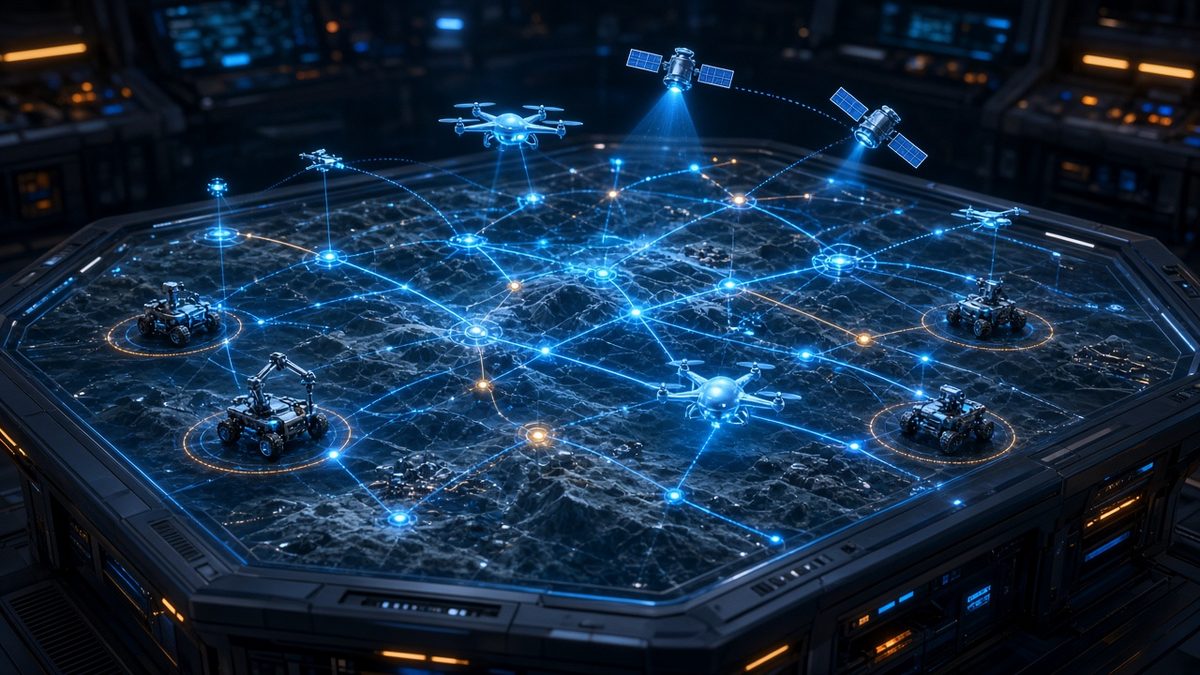
Now another layer is emerging: artificial intelligence and autonomous systems capable of sensing, identifying, coordinating and potentially acting with decreasing human intervention.
The transformation is no longer theoretical.
On September 30, U.S. Defense Secretary Pete Hegseth announced the creation of a new Autonomous Warfare Command, a four-star command intended to expand the military’s use of autonomous and robotic systems, including drones and artificial intelligence. Reuters reported that it would become the military’s newest major command since the creation of U.S. Space Command in 2019.
Two days later, the U.S. Army announced its own autonomous-systems command structure, demonstrating that the change is not confined to one Pentagon program. The Army is establishing a command focused on autonomous systems and an acquisition executive responsible for accelerating the procurement and deployment of these technologies.
The message is increasingly clear:
The world’s militaries are preparing for a battlefield in which machines, software and humans operate as an integrated system.
Ukraine Is Becoming a Laboratory for AI Warfare
The Russia-Ukraine war has provided something that military laboratories normally cannot reproduce: enormous amounts of real-world battlefield data.
Drones are recording combat operations continuously. Sensors are identifying vehicles, artillery, air-defense systems, infantry and aircraft. Electronic warfare is disrupting communications and navigation. Both sides are rapidly modifying their systems in response to what happens on the battlefield.
Britain is now attempting to turn that experience into a new generation of autonomous military technology.
The British Ministry of Defence announced in September that up to 12 British companies would receive access to Ukrainian battlefield data to develop AI models for advanced drone swarms.
The database contains sensor information from more than 6 million battlefield detections, including tanks, artillery, air-defense systems, infantry, Shahed drones and reconnaissance UAVs.
This matters because AI systems require data.
A military can spend billions of dollars building aircraft, missiles and ships, but increasingly it may also need another strategic resource:
battlefield data.
The basic cycle is becoming:
Combat → Data → AI training → Better systems → Combat → More data.
That creates the possibility of a technological feedback loop in which actual combat experience accelerates the development of the next generation of weapons.
Drone Versus Drone
Ukraine is also demonstrating another feature of the emerging battlefield: the weapon and the counterweapon can evolve simultaneously.
Russia has introduced increasingly fast jet-powered drones into attacks against Ukraine. According to the Associated Press, the drones can travel at speeds and altitudes that create serious problems for existing Ukrainian air-defense systems. Ukrainian manufacturers are responding by developing faster interceptor drones, including systems incorporating onboard AI.
This is more than a race between two types of aircraft.
It is a competition between systems.
One side develops a drone.
The other develops a detection system.
The first side modifies its drone.
The second develops a new interceptor.
The first side changes its tactics.
The second side retrains its algorithms.
The result is a rapidly evolving technological contest in which software can become almost as important as the physical weapon.
America Is Reorganizing for Autonomous Warfare
The Pentagon’s creation of the Autonomous Warfare Command represents a significant institutional development.
Military organizations are built around the technologies they expect to use. The creation of a dedicated command suggests that autonomous and robotic systems are increasingly being treated not as specialized equipment but as a central component of future military operations.
The Army’s parallel autonomous-systems initiative reinforces this direction.
The implications extend beyond drones.
Autonomous technology can potentially be applied to:
- aerial reconnaissance
- air defense
- maritime surveillance
- ground vehicles
- logistics
- electronic warfare
- battlefield mapping
- target detection
- communications
- intelligence analysis
- command-and-control
- supply operations
The ultimate objective is not necessarily to replace soldiers with robots.
It may be to create a military in which human personnel command and cooperate with large numbers of increasingly capable machines.
The New Military Kill Chain
Traditional military operations can be understood as a sequence:
Find → Identify → Decide → Strike → Assess.
AI has the potential to compress that sequence.
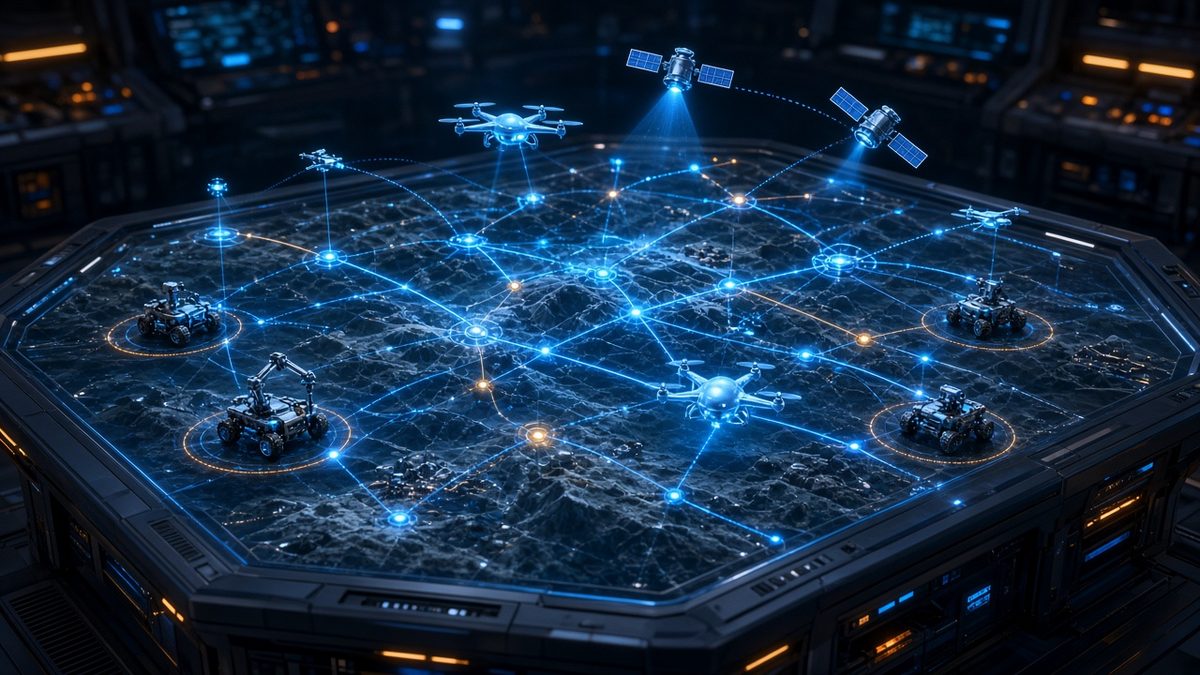
The emerging architecture could look like:
Satellite → Sensor → Drone → AI → Identification → Command Network → Weapon → Assessment → New Data
The advantage is potentially enormous.
If one military can detect an enemy formation ten minutes earlier, identify it more accurately and coordinate a response while the opposing force is still processing the information, that military may gain a decisive operational advantage.
The critical resource becomes decision time.
Military competition could therefore increasingly become a competition over who can transform information into action fastest.
The Economics of Autonomous Warfare
There is also an economic revolution developing underneath the technological one.
Traditional military platforms can cost enormous sums of money.
A fighter aircraft, warship or sophisticated missile may represent years of development and millions or billions of dollars in investment.
Small autonomous systems can potentially be manufactured in much larger numbers.
This creates an important question:
What happens when inexpensive autonomous systems can threaten extremely expensive military platforms?
The issue is not simply the price of an individual drone.
It is the cost exchange ratio.
If a relatively inexpensive autonomous system can force an opponent to expend a much more expensive interceptor, the economics of warfare change.
If thousands of autonomous systems can be produced rapidly, mass may begin to matter alongside technological sophistication.
This could push militaries toward a combination of:
high-end platforms + large numbers of inexpensive autonomous systems.
That is one reason the Pentagon’s emphasis on both quality and quantity is significant. Reuters reported that the new autonomous-warfare initiative reflects a broader push toward systems that can be produced and deployed at scale.
China and the Race for Intelligentized Warfare
The United States is not operating in isolation.
China has spent years developing what it describes as increasingly “intelligentized” warfare, incorporating artificial intelligence, autonomous systems, robotics, electronic warfare and networked command systems into military planning.
The strategic competition therefore extends beyond individual weapons.
It includes:
- semiconductors
- computing power
- AI models
- data
- robotics
- manufacturing capacity
- satellite networks
- communications
- electronic warfare
- military software
This is why the AI military competition is also an economic competition.
A country that controls advanced semiconductor manufacturing, large-scale computing infrastructure, AI research and mass production may possess advantages extending across the entire military technology ecosystem.
The Data Race May Be as Important as the Arms Race
The most overlooked element of this transformation may be data.
An autonomous system needs to understand its environment.
That requires enormous quantities of information about:
- terrain
- weather
- vehicles
- weapons
- human behavior
- electromagnetic signals
- military formations
- aircraft
- drones
- infrastructure
Ukraine’s millions of battlefield detections illustrate the potential value of operational data.
The British government is explicitly attempting to turn that data into military AI capabilities.
That creates a new strategic resource:
combat experience converted into machine-readable data.
The country that gathers the most relevant data, processes it fastest and incorporates the lessons into production may be able to shorten the military innovation cycle.
But AI Does Not Eliminate Human Problems
The rise of autonomous warfare does not mean machines will automatically make perfect decisions.
The battlefield remains an extraordinarily difficult environment.
Smoke, weather, camouflage, electronic interference, damaged sensors, deceptive signals and civilian activity can all complicate identification.
An AI system can also make mistakes.
That creates one of the central questions of autonomous warfare:
Where does human responsibility remain?
There is a significant difference between using AI to help a soldier identify a potential target and allowing an autonomous system to select and engage targets without direct human authorization.
The technological debate is therefore inseparable from questions of command, accountability and international law.
The Six-Lens View of AI Warfare
The transformation can be understood through six interconnected lenses.
1. Geography
Autonomous systems can operate across enormous geographic spaces, particularly where maintaining large numbers of personnel is difficult.
2. Military Power
Drones, robotics, autonomous vehicles, AI-enabled intelligence and electronic warfare are becoming increasingly interconnected.
3. Alliances
Ukraine’s cooperation with Britain demonstrates how battlefield technology can move between allies and defense industries.
4. Economics
Autonomous systems potentially change the cost structure of warfare by allowing countries to produce large quantities of relatively inexpensive systems.
5. Technology
AI, semiconductors, sensors, satellite communications, robotics and software are becoming components of the same military architecture.
6. Power and Leverage
The ultimate competition may be over who can see first, understand first, decide first and act first.
The Battlefield of the Future
The future battlefield may not look like science fiction.
It may look surprisingly familiar.
Soldiers will still operate vehicles. Ships will still patrol oceans. Aircraft will still fly. Missiles will still exist.
But surrounding them could be enormous networks of autonomous systems.
A commander could have access to hundreds or thousands of drones.
Sensors could continuously monitor an area.
AI systems could process enormous amounts of information.
Autonomous vehicles could transport supplies.
Robotic systems could operate in dangerous environments.
Human commanders could increasingly supervise networks of machines rather than personally directing every individual platform.
That is a fundamental change in military organization.
The New Arms Race
The emerging AI arms race is therefore not simply:
America vs. China
or
Russia vs. Ukraine.
It is a competition over an entire technological ecosystem.
The countries that succeed will need:
- AI researchers
- semiconductors
- data centers
- energy
- software
- robotics
- manufacturing
- battlefield data
- secure communications
- satellites
- military doctrine
and, ultimately, trained personnel capable of integrating all of them.
The war of the future may therefore be decided long before the first shot is fired.
It may be decided in semiconductor factories, data centers, software laboratories, drone factories and military testing ranges.
Conclusion
The AI revolution in warfare has moved beyond speculation.
The United States is establishing a major command dedicated to autonomous warfare. The Army is creating its own autonomous-systems structure. Britain is using Ukrainian battlefield data to accelerate AI drone development. Ukraine is developing AI-enabled interceptors against increasingly sophisticated Russian drones.
These developments point toward a battlefield where data, software, machines and humans operate as one interconnected system.
The central military question of the next decade may not simply be:
Who has the biggest army?
It may increasingly be:
Who can turn information into action fastest—and who can do it at the greatest scale?
The AI war is not necessarily a future event.
The transition is already underway.
Related coverage
- Russia’s Geran jet drone production
- Russia’s ground drones and their limits
- China’s air drones, wingmen and swarms
- Russia’s naval drones and the Poseidon status
Sources
- Reuters via Honolulu Star-Advertiser, Pentagon creates ’Autowarcom’ to expand AI and drone capabilities, 30 September 2026.
- Air & Space Forces Magazine, Hegseth Unveils New Autonomous Warfare Command in ’State of the Force’ Address, 30 September 2026.
- U.S. Army, Army announces Futures and Autonomous Systems Command, 2 October 2026.
- Breaking Defense, Army to establish new autonomy command, acquisition executive, 2 October 2026.
- UK Ministry of Defence (GOV.UK), British companies to access prized Ukraine data to develop AI drone swarms, 25 September 2026.
- Associated Press via ABC News, Drones outpace Ukrainian defenses as manufacturers race to build new interceptors, 1 October 2026.