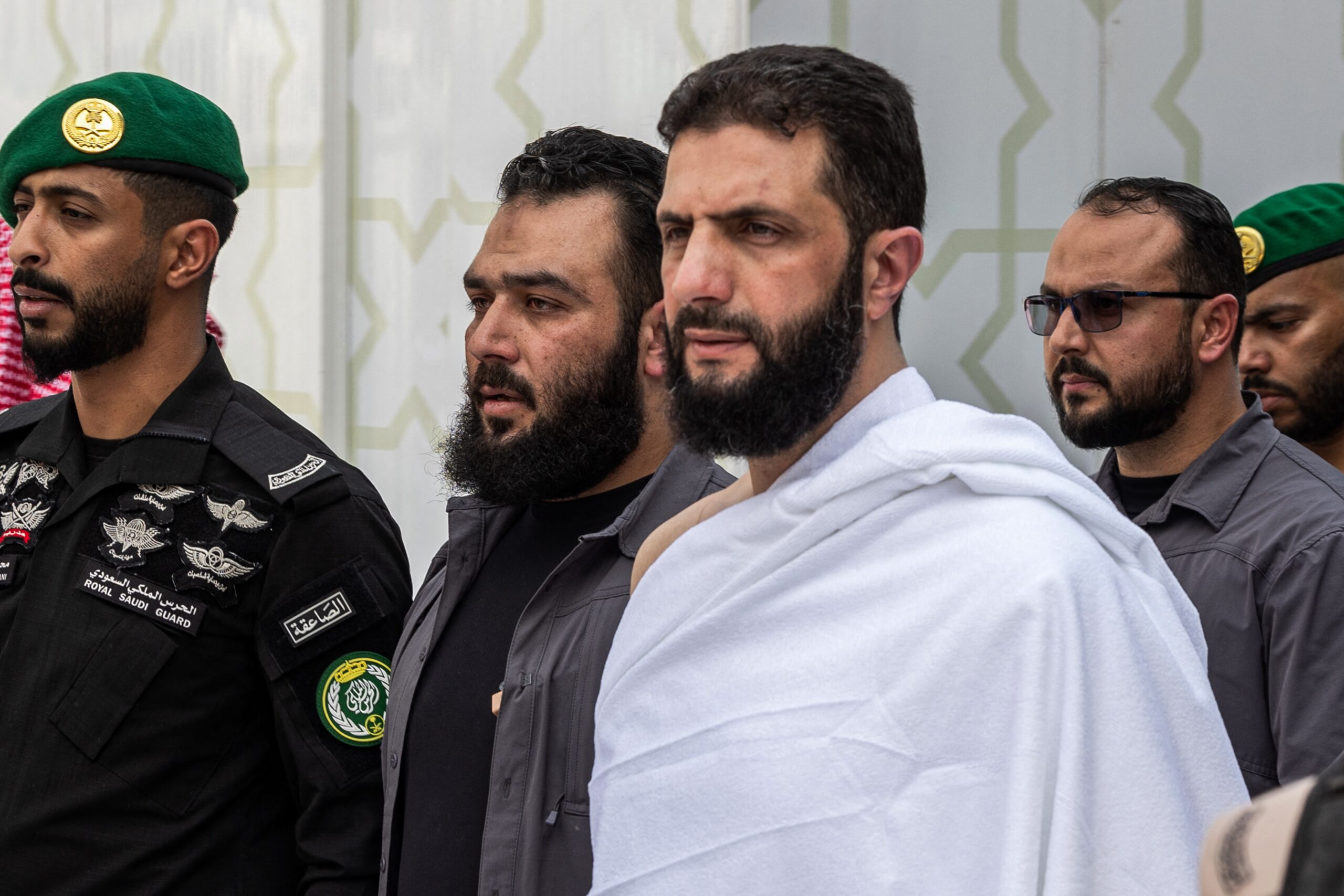
Ahmed al-Sharaa (full name: Ahmed Hussein al-Sharaa; born 29 October 1982) is the current President of Syria. He previously led the Islamist rebel group Hay’at Tahrir al-Sham (HTS) and played a central role in the December 2024 offensive that overthrew Bashar al-Assad’s regime. He is also known by his former nom de guerre, Abu Mohammad al-Jolani (or al-Julani).(en.wikipedia.org)
Early Life Al-Sharaa was born in Riyadh, Saudi Arabia, to a middle-class Syrian Sunni Muslim family originally from the Golan Heights. The family returned to Syria in 1989 and settled in Damascus. He studied media and briefly medicine at Damascus University before dropping out. He was radicalized in the early 2000s, particularly by the Second Palestinian Intifada and the broader context of regional conflicts and the U.S. invasion of Iraq.
Prior Affiliations and Militant CareerAl-Sharaa’s early militant path was deeply tied to al-Qaeda:
- 2003–2011: He joined al-Qaeda in Iraq (AQI) shortly before the U.S. invasion. He fought in the Iraqi insurgency for about three years. U.S. and Iraqi forces captured him in 2006 while he was planting explosives. He was held for over five years in various U.S. detention facilities in Iraq (including Abu Ghraib, Camp Bucca, and others). He was released in March 2011. britannica.com
- 2012–2016: Tasked by al-Qaeda leadership (including Ayman al-Zawahiri), he founded Jabhat al-Nusra (al-Nusra Front) in January 2012 as al-Qaeda’s official Syrian branch. It received initial support and funding from AQI (later ISIS). Under his leadership, al-Nusra gained territory in Idlib and parts of Syria, provided some social services, but was also involved in suicide bombings, clashes with other groups, and documented atrocities against civilians (including minorities). He resisted a full merger with ISIS and publicly denounced it in 2014. en.wikipedia.org
- 2016–2017: In July 2016, al-Nusra formally broke ties with al-Qaeda and rebranded as Jabhat Fatah al-Sham. In January 2017, it merged with other rebel factions to form Hay’at Tahrir al-Sham (HTS), with al-Sharaa as its emir (leader). HTS became the dominant force in Idlib province and established the Syrian Salvation Government (SSG), a technocratic administration. britannica.com
During his Nusra/early HTS period (especially 2014–2015), his rhetoric was explicitly hostile toward the United States. He described U.S.-led coalition airstrikes against ISIS as an “assault on Islam” and warned that they would bring the battle to Western lands. He condemned Syrian factions accepting Western aid and money, and stated that HTS/Nusra would fight the U.S. and its allies.
Current Position and Governance (as of 2026)Al-Sharaa led the rapid HTS-led offensive in late 2024 that captured Aleppo, Hama, Homs, and Damascus, forcing Assad to flee to Russia on 8 December 2024. He became Syria’s de facto leader immediately afterward. On 29 January 2025, at the Syrian Revolution Victory Conference, he was formally appointed President of Syria’s interim/transitional government for a transitional period (initially framed around a five-year constitutional process).
Key developments under his leadership:
- HTS and other armed factions were formally dissolved or integrated into state structures.
- He has pursued a pragmatic, Syrian-nationalist approach, emphasizing reconstruction, refugee returns, minority inclusion (with mixed results amid reported sectarian incidents), and economic stabilization.
- Internationally, he has engaged with regional powers (Turkey, Qatar, Saudi Arabia, UAE), Russia, and Western countries. The U.S. and others lifted or suspended many sanctions; his personal terrorist designation was revoked in late 2025. britannica.com
How He Speaks About the USAAl-Sharaa’s rhetoric toward the United States has undergone a dramatic shift from outright hostility to pragmatic engagement and partnership-seeking.
Historical stance (2012–2016 era): Strongly adversarial. He portrayed the U.S. as an enemy of Islam/Muslims, opposed Western intervention, and rejected cooperation against ISIS if it involved accepting U.S. support.
Post-2016 shift: After breaking with al-Qaeda, he focused rhetoric on the Syrian regime, Hezbollah, and ISIS, while denying plans to attack the West or use Syria as a base for global jihad. He began appealing for pluralism and coexistence in a post-Assad Syria.
Since assuming power (2025–2026): Highly pragmatic and positive toward engagement with the U.S. He has repeatedly sought the lifting of remaining U.S. sanctions (e.g., Caesar Act remnants), describing them as obstacles to reconstruction. He has praised U.S. President Donald Trump’s decisions to lift or suspend sanctions as “historic and courageous.”(abcnews.com)
- Meetings with Trump:
- He met Trump in Riyadh (May 2025) and at the White House (November 2025 — the first visit by a Syrian president to the Oval Office). Discussions focused on strengthening bilateral ties, counter-ISIS cooperation, sanctions relief, and regional stability. Trump publicly praised al-Sharaa’s leadership and expressed optimism about Syria’s future. (durham.ac.uk)
- Fox News interview (November 2025): During his U.S. visit, he described past al-Qaeda links as “a matter of history” (not raised in the Trump meeting). He called Syria a potential “geopolitical ally” of the U.S. and a partner against ISIS (Daesh). He stated Syria would not join the Abraham Accords at present due to Israel’s occupation of the Golan Heights but left the door open for future negotiations facilitated by the U.S. (jpost.com)
- Other statements: He has expressed willingness for long-term dialogue with Israel on the Golan, urged negotiations to resolve U.S.-Israeli tensions with Iran (while keeping Syria outside that conflict unless directly targeted), and emphasized mutual interests, sovereignty, and economic partnerships with the West. Syria publicly joined the global anti-ISIS coalition in November 2025. (chathamhouse.org)
In meetings with U.S. officials (including Congress), he has signaled a desire to “liberate from the past” and become “a great ally to the United States.”
Summary Assessment
Ahmed al-Sharaa represents one of the most striking transformations in recent Middle Eastern politics: from a U.S.-imprisoned al-Qaeda operative and designated terrorist ($10 million bounty) to the president of Syria engaging directly with U.S. leaders. His evolution reflects a strategic pivot from transnational jihadism to Syrian state-building and realpolitik. While early rhetoric was virulently anti-American, his current public statements emphasize partnership, counterterrorism cooperation (especially against ISIS), sanctions relief, and pragmatic foreign policy. U.S. engagement appears driven by shared interests in stability, counter-ISIS efforts, and preventing state failure or Iranian resurgence in Syria.
This report is based on open-source reporting from Wikipedia, Britannica, major news outlets (NYT, CNN, Fox News, Al Jazeera, etc.), and think-tank analyses up to mid-2026. His governance continues to face challenges regarding inclusivity, security, and economic recovery.