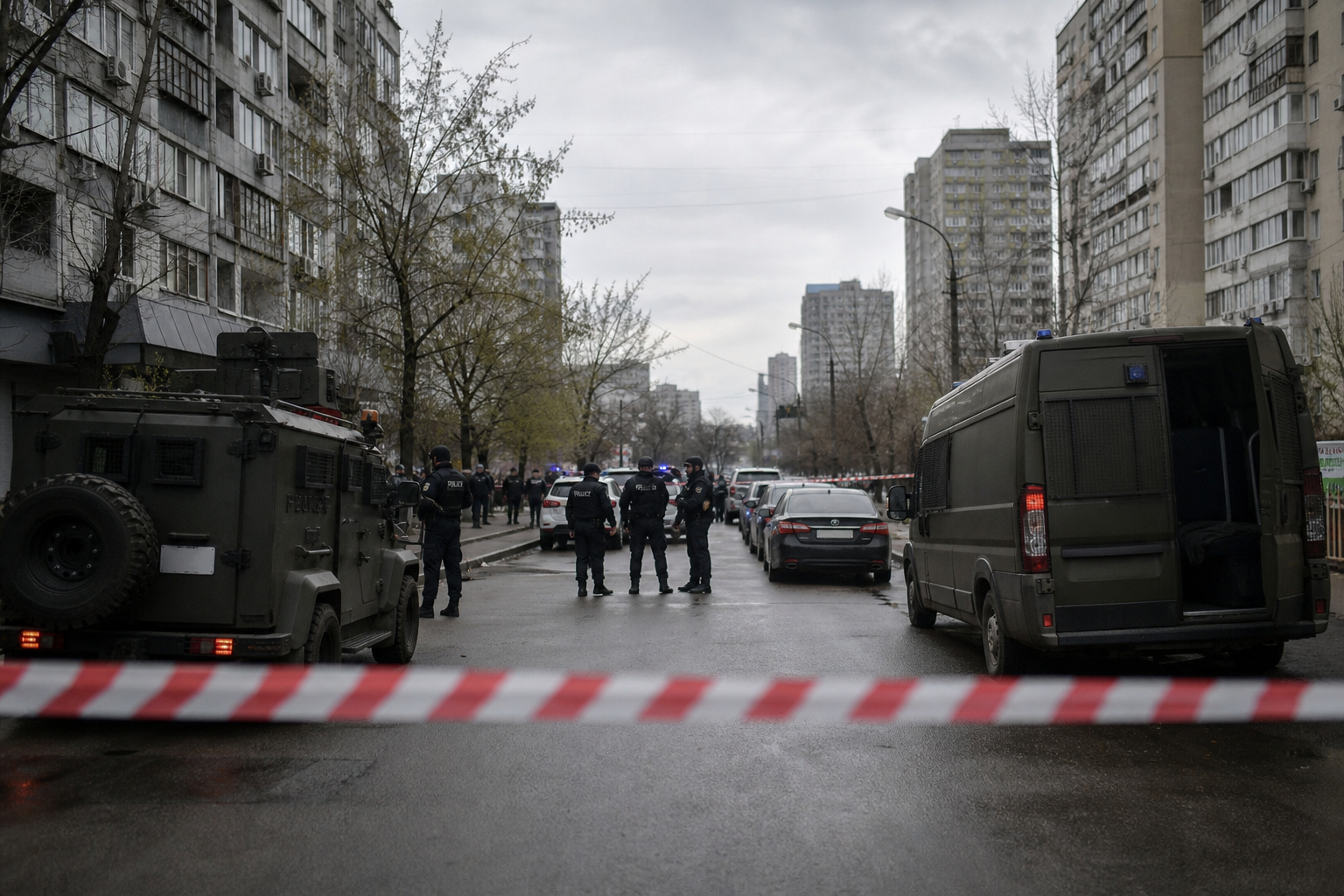
KOHAT / ISLAMABAD — September 18, 2026. A vehicle packed with explosives rammed a mosque inside the Old Police Lines complex in Kohat during Friday prayers, and a second suicide blast struck near the Special Branch as gunmen fought security forces, killing at least sixteen people — eleven civilians and five police officers — in one of the deadliest recent attacks on a police facility in Khyber Pakhtunkhwa.
Khyber Pakhtunkhwa Inspector General Zulfiqar Hamid described the assault as a suicide attack, according to Reuters and other wire reports. Officials said a gun battle continued after the vehicle-borne blast, with at least one attacker killed and a clearance operation underway; some Pakistani outlets reported additional militants neutralized as the fight stretched on. More than fifty people were wounded in early tallies that remained fluid Friday afternoon. The mosque’s location beside police headquarters made the timing — congregational prayers — a deliberate strike on both worshippers and the security apparatus that uses the compound.
Condemnation came quickly from the top of the state. President Asif Ali Zardari issued wishes for the injured’s recovery. Prime Minister Shehbaz Sharif condemned the blast. Khyber Pakhtunkhwa Chief Minister Muhammad Sohail Afridi joined provincial officials in denouncing the attack as terrorism against civilians and police alike. No group had claimed responsibility in the first hours — a familiar pattern in a theater where Islamic State Khorasan Province and the Tehreek-e-Taliban Pakistan both retain attack capacity and often stay silent until propaganda cycles catch up.
The geography is the strategic context. Kohat sits in a province that has absorbed a sharp rise in militancy over recent months, with police and military targets hit along routes that connect to the Afghanistan border. Islamabad accuses militants of using Afghan soil to train and plan; the Taliban government in Kabul denies the charge and calls the violence Pakistan’s internal problem. That diplomatic deadlock leaves Pakistani forces fighting a cross-border ecosystem with domestic political constraints and limited verification of sanctuary claims.
For KP’s police, the Old Police Lines strike is an institutional wound: a house of worship inside a security complex turned into a kill zone during Friday prayers. For the federal government, it is another stress test of counterterrorism capacity while Pakistan balances Gulf, Afghan and great-power files. For civilians in Kohat, the casualty mix — mostly worshippers, plus the officers meant to protect them — restates how militants erase the line between soft and hard targets when they want maximum shock.
Investigators will hunt the cell, the VBIED supply chain and any cross-border facilitation. Politicians will promise resolve. The operational question is whether Friday’s attack is a one-off spectacle or the opening of another concentrated campaign against police mosques and compounds in the northwest. Until a claim or a charge sheet lands, the verified facts remain grim enough: sixteen dead, dozens wounded, a mosque breached by a bomb truck, and a gunfight still echoing through a police lines complex that was supposed to be one of the safer addresses in Kohat. In a province where Friday prayers and police duty increasingly share the same target list, the Old Police Lines attack is both a local atrocity and a national warning about the tempo of northwestern militancy. How quickly investigators name a network — and how honestly Kabul and Islamabad address the sanctuary dispute — will shape whether Kohat becomes another grim statistic or a turning point in Pakistan’s border security debate.