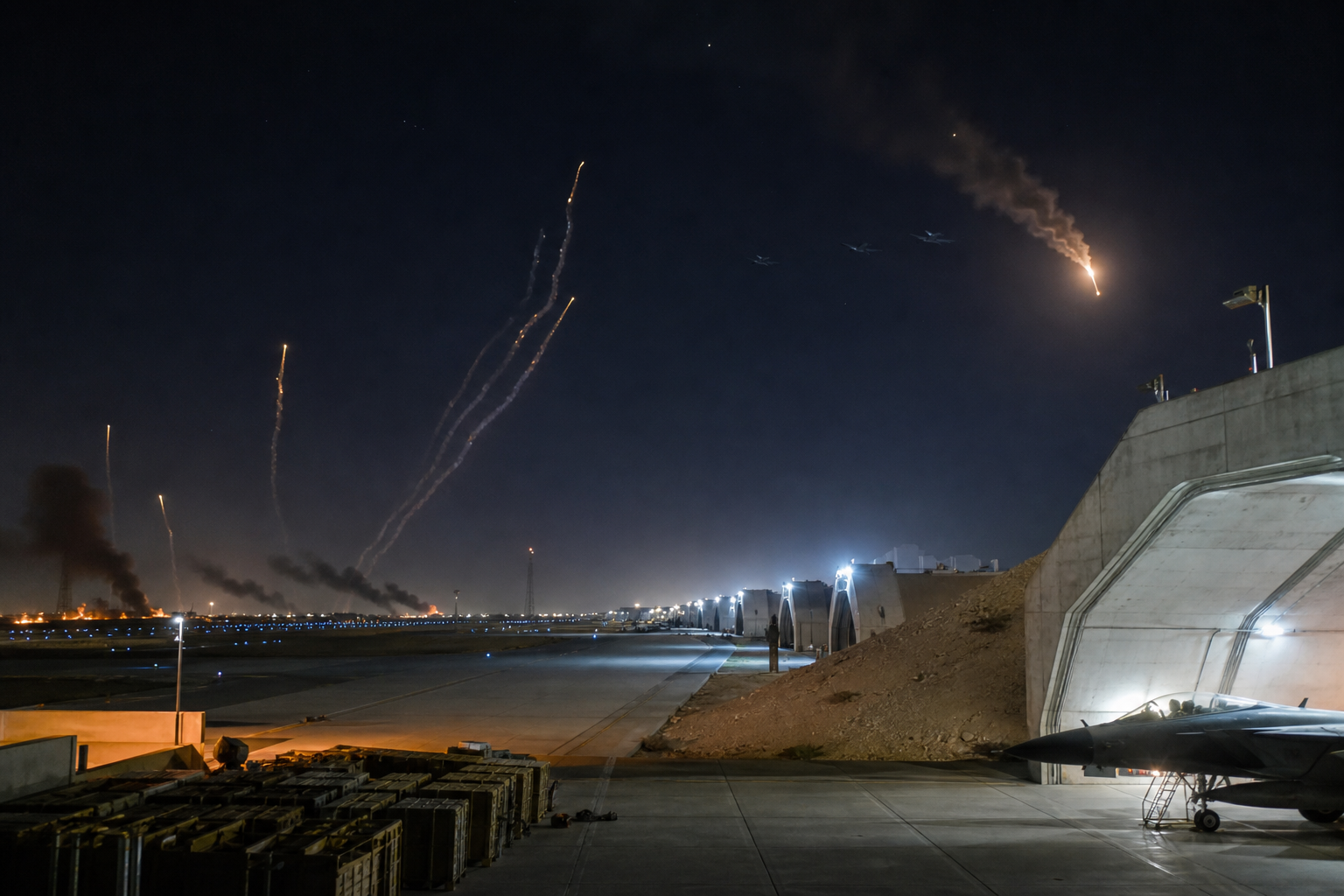
Kuwait’s armed forces said Thursday, September 3, 2026, that they were intercepting an Iranian missile and drone attack, as Tehran claimed it had struck the Ahmad al-Jaber Air Base — a U.S.-linked facility on Kuwaiti territory — deepening a Gulf escalation that began with renewed American raids over the preceding weekend.
Iranian military statements framed the Kuwait operation as part of a wider retaliatory package against American bases and forces after U.S. strikes on Iranian targets, including coastal sites near the Strait of Hormuz. Tehran also claimed a hit on Al Minhad Air Base in the United Arab Emirates; Abu Dhabi did not corroborate that claim. Kuwait, by contrast, publicly described the incoming fire as a direct threat to its security, stability, and the safety of residents, and as a grave breach of international law.
The Thursday barrage sits inside a six-month war that erupted after U.S. and Israeli strikes on Iran in late February 2026 killed Supreme Leader Ayatollah Ali Khamenei. A fragile ceasefire collapsed in July amid attacks on commercial shipping through Hormuz. After weeks of relative quiet, Washington resumed strikes on Sunday, Iran answered across Jordan, Bahrain, Kuwait, Iraq’s Kurdistan region, and the UAE, and both sides returned to open exchanges.
For Kuwait, the politics are as sharp as the air defense problem. Hosting American forces while Iranian projectiles overfly or target national airspace forces a small Gulf monarchy to choose between deterrence messaging, quiet diplomacy with Tehran, and alliance management with Washington. Public condemnation of Iranian attacks protects sovereignty claims; continued U.S. basing keeps Kuwait inside America’s regional posture even as the war’s economic and political costs climb.
The operational picture remains contested. Iranian state media broadcast claims of successful strikes; Kuwait emphasized interceptions; independent battle-damage assessment of Ahmad al-Jaber was not immediately available. What is clear is the geographic widening: Iran is treating the network of U.S. facilities across the Gulf Cooperation Council states as a single retaliatory map, not a set of isolated bases.
That map matters for escalation control. Every Kuwaiti or Emirati intercept is a reminder that American–Iranian fighting is no longer a bilateral exchange over Hormuz alone. It is a multi-state air and missile war fought on the territory of partners who did not choose the February opening but now absorb the Tuesday-to-Thursday aftershocks. If Tehran keeps pressing GCC hosts, Washington faces pressure either to harden those bases further or to force a ceasefire before alliance politics fracture under missile traffic.