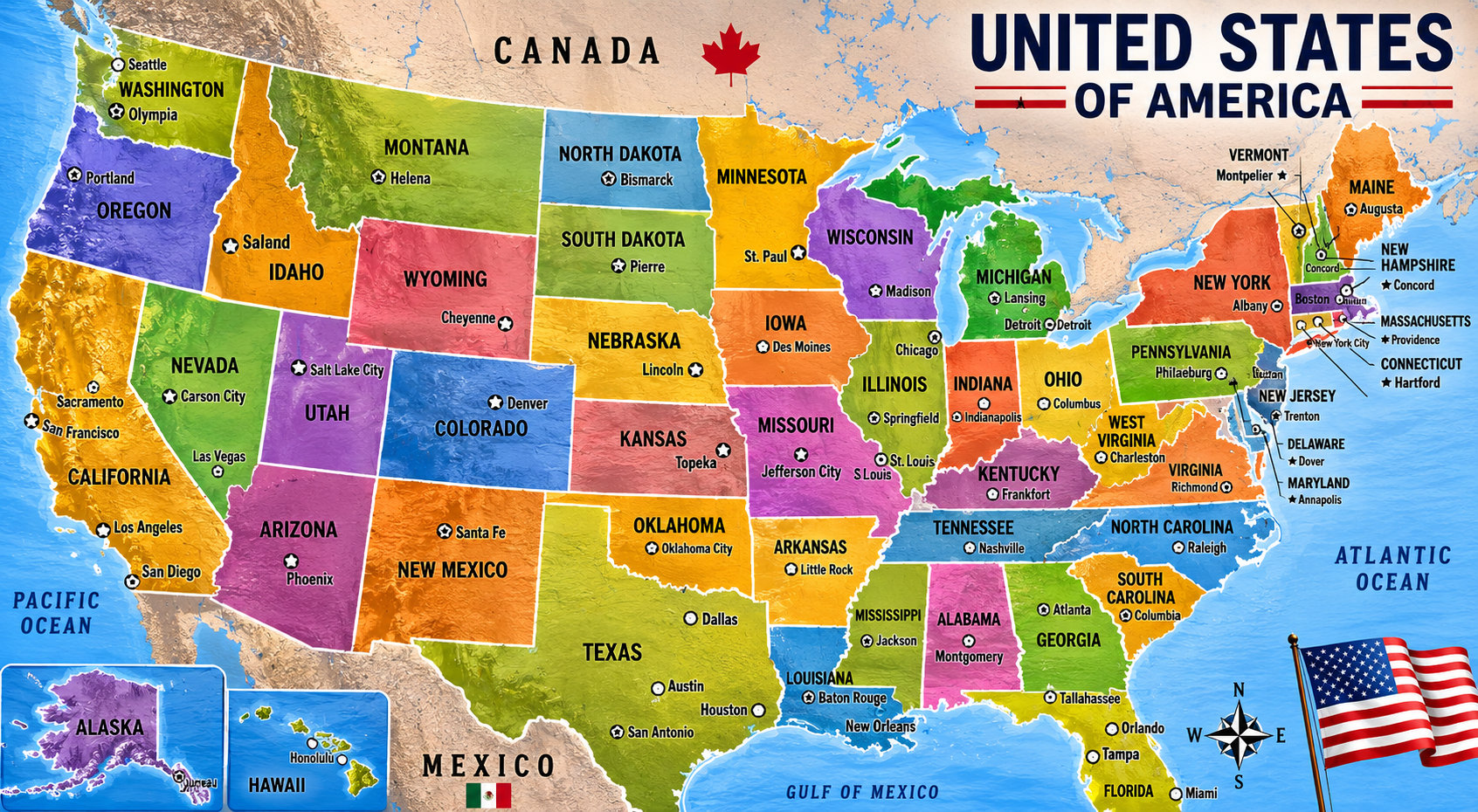
The United States of America (USA) is one of the world’s most influential nations, known for its economic power, military strength, technological innovation, and democratic institutions. Located in North America, the United States was founded in 1776 and has grown from a collection of thirteen British colonies into a global superpower. Its history is marked by revolution, expansion, civil conflict, industrial growth, and a continuing struggle to fulfill its founding ideals of liberty and equality.
Early America Before European Settlement
Long before Europeans arrived, North America was home to millions of Indigenous peoples belonging to hundreds of nations and cultures. These included civilizations such as the Mississippian culture, the Pueblo peoples of the Southwest, and the Iroquois Confederacy in the Northeast.
Native American societies developed complex political systems, trade networks, agriculture, and cultural traditions that flourished for thousands of years.
European Colonization (1492–1775)
Following the voyages of Christopher Columbus in 1492, European powers began exploring and colonizing the Americas.
The British established permanent settlements along the Atlantic coast, including:
- Jamestown (1607), the first permanent English settlement.
- Plymouth Colony (1620), founded by the Pilgrims.
Over time, thirteen British colonies emerged. The colonies developed representative governments and strong local identities while remaining under British rule.
The American Revolution (1775–1783)
Tensions between Britain and the colonies increased after the British government imposed new taxes following the French and Indian War.
Key events included:
- The Boston Tea Party (1773)
- Battles of Lexington and Concord (1775)
- Publication of the Declaration of Independence on July 4, 1776
Led by figures such as George Washington, Thomas Jefferson, and Benjamin Franklin, the colonies fought Britain for independence.
The war ended with the Treaty of Paris, which recognized American independence.
Founding the Republic (1783–1800)
After independence, the United States adopted the United States Constitution, creating a federal government with three branches:
- Executive (President)
- Legislative (Congress)
- Judicial (Supreme Court)
In 1789, George Washington became the nation’s first president.
The Bill of Rights guaranteed important freedoms including speech, religion, and due process.
Westward Expansion (1800–1860)
The United States expanded rapidly across North America.
Major developments included:
- The Louisiana Purchase from France.
- The expedition of Meriwether Lewis and William Clark.
- Annexation of Texas.
- Acquisition of western territories after the Mexican-American War.
This expansion dramatically increased the nation’s size but also led to conflict with Native American tribes and debates over slavery.
The Civil War (1861–1865)
One of the most significant events in American history was the American Civil War.
The conflict arose largely from disagreements over slavery and states’ rights.
The Union (Northern states) fought the Confederacy (Southern states). Under President Abraham Lincoln, the Union prevailed.
Major outcomes included:
- Preservation of the United States as one nation.
- Abolition of slavery through the 13th Amendment.
- Expansion of federal authority.
Lincoln was assassinated shortly after the war ended.
Industrialization and World Power (1865–1914)
Following the Civil War, the United States underwent rapid industrial growth.
Major industries included:
- Railroads
- Steel
- Oil
- Manufacturing
Business leaders such as Andrew Carnegie and John D. Rockefeller built vast enterprises.
Millions of immigrants arrived from Europe, helping fuel economic growth.
By the early 20th century, the United States had become one of the world’s largest economies.
World War I and the Roaring Twenties (1914–1929)
The United States entered World War I in 1917.
American forces helped the Allied Powers achieve victory in 1918.
The 1920s brought:
- Economic growth
- Consumer culture
- Technological innovation
- Expansion of automobiles and radio
Women gained voting rights through the 19th Amendment in 1920.
The Great Depression and World War II (1929–1945)
The stock market crash of 1929 triggered the Great Depression.
President Franklin D. Roosevelt introduced the New Deal to combat unemployment and economic hardship.
The United States entered World War II after the Japanese attack on Attack on Pearl Harbor.
The war ended in 1945 after Allied victory over Germany and Japan.
The Cold War (1945–1991)
Following World War II, the United States emerged as a superpower alongside the Soviet Union.
The Cold War involved:
- Nuclear competition
- Proxy wars
- Space exploration
- Ideological rivalry
Major events included:
- The Korean War
- The Vietnam War
- The Cuban Missile Crisis
- The Apollo 11 Moon Landing
The Cold War ended with the collapse of the Soviet Union in 1991.
Civil Rights Movement
During the 1950s and 1960s, Americans fought to end racial segregation and discrimination.
Key leaders included:
- Martin Luther King Jr.
- Rosa Parks
- Malcolm X
Major achievements included:
- Civil Rights Act of 1964
- Voting Rights Act of 1965
The Modern United States (1991–Present)
After the Cold War, the United States remained the world’s leading military and economic power.
Major events include:
- The September 11 attacks
- Wars in Afghanistan and Iraq
- The 2008 financial crisis
- The COVID-19 pandemic
- Rapid advances in artificial intelligence, biotechnology, and information technology
The nation continues to debate issues including immigration, healthcare, economic inequality, national security, and America’s role in the world.
The history of the United States is a story of revolution, expansion, innovation, conflict, and transformation. From thirteen colonies on the Atlantic coast to a global superpower, the United States has played a major role in shaping modern world history. Its development has been driven by democratic ideals, economic opportunity, technological progress, and the ongoing effort to balance freedom, equality, and national unity.