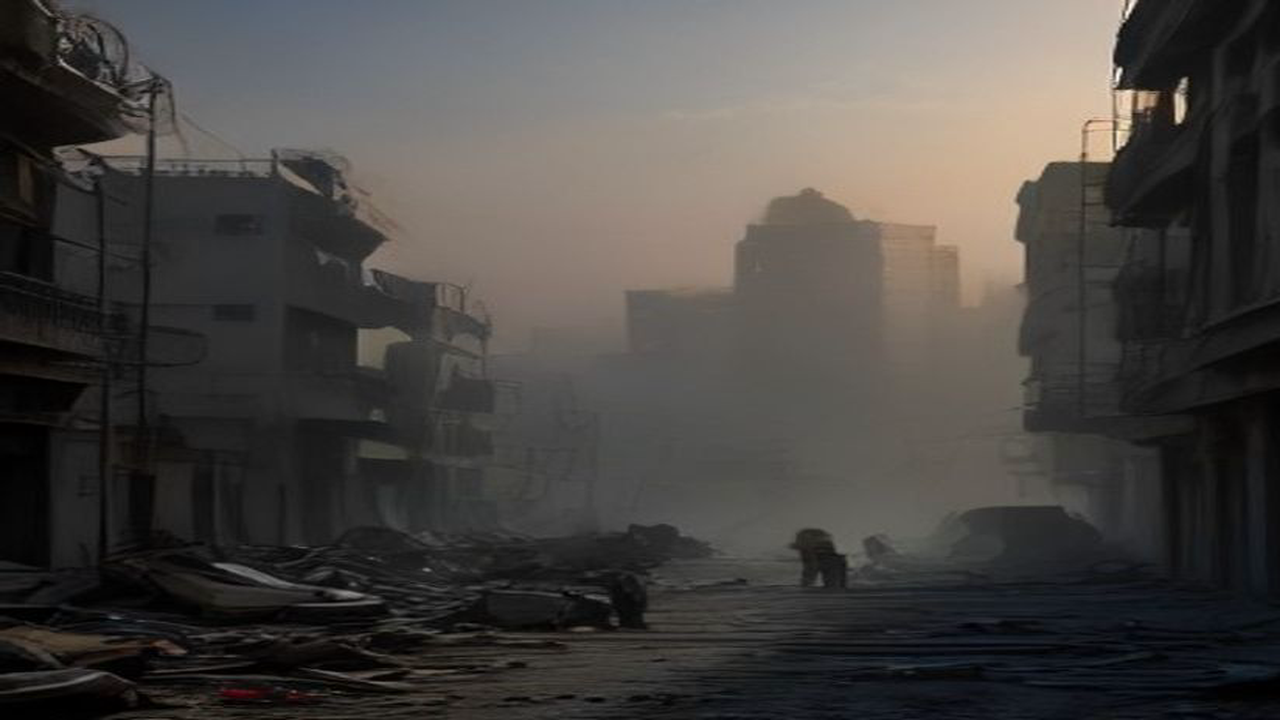
GAZA CITY — September 16, 2026. A war-damaged residential building in Gaza collapsed overnight, killing at least twelve people including five children, Gaza civil defence teams said, with roughly one hundred people feared trapped in the rubble according to early tallies carried by Reuters — a structural catastrophe layered onto years of bombardment, and one that The Guardian’s parallel reporting put at sixteen or more dead as rescue work continued.
Civil defence crews described a multi-story apartment block that had already been weakened by prior Israeli strikes, then failed overnight under its own compromised weight, dust, and aftershocks of a conflict that has left countless façades standing as shells. Rescuers worked with hand tools and limited heavy equipment, a familiar constraint in Gaza where fuel, machinery, and safe access lanes remain scarce. Early survivor pulls were interrupted by fears of secondary collapses as adjacent walls shifted.
Civil defence officials stressed that the overnight death toll was provisional while tunneling through concrete slabs continued. Reuters’ count of at least twelve dead, five of them children, and about one hundred people unaccounted for inside the wreckage set the morning baseline for international wires. The Guardian’s higher fatality figure of sixteen or more reflected the same chaotic scene with different cutoffs as bodies were identified — a discrepancy common in the first hours of urban collapses when lists diverge faster than families can be notified.
Israeli military authorities have long argued that buildings used by Hamas or damaged in lawful strikes remain hazardous and that responsibility for civilian presence in compromised structures sits with militant groups that embed among residential blocks. Palestinian officials and local medical sources reject that framing for overnight collapses, casting them as delayed lethality from earlier bombardments that left families with nowhere structurally sound to sleep. The argument will not rebuild the stairwells.
The humanitarian arithmetic is brutal even before politics. Five children among the confirmed dead turns an engineering failure into a moral flashpoint for governments that fund aid corridors and for publics already saturated with Gaza casualty imagery. Roughly one hundred people trapped implies a dense residential occupancy that civil defence cannot clear quickly without cranes, cutting torches, and uninterrupted ambulance routes — assets that ceasefires and aid deals have struggled to guarantee for sustained rescue windows.
International agencies monitoring Gaza’s housing stock have warned for months that partially destroyed towers are ticking structural bombs, especially after winter rains and after repeated nearby detonations. Overnight collapse without a fresh airstrike in the immediate moment does not erase the strike history civil defence attributes to the building; it does complicate attribution headlines that prefer a single munition timestamp. Both facts hold: prior war damage, and a deadly failure while people slept.
Regional diplomacy around Gaza remains stalled relative to the urgency on the ground. Ceasefire talks, hostage calculations, and Rafah crossing politics move on weekly clocks; rubble does not wait. Each collapse that kills children hardens positions: Israeli officials fear images will be weaponized regardless of cause; Palestinian authorities demand accountability for the original strikes that hollowed the structure.
As dawn counts settled between the Reuters and Guardian tallies, the operational picture was unchanged — civil defence digging, families waiting, a building that had already been hit finally giving way. At least twelve dead, five of them children, around one hundred feared trapped: that is the morning ledger from Gaza, and it will rise or fall with every slab the rescuers lift.