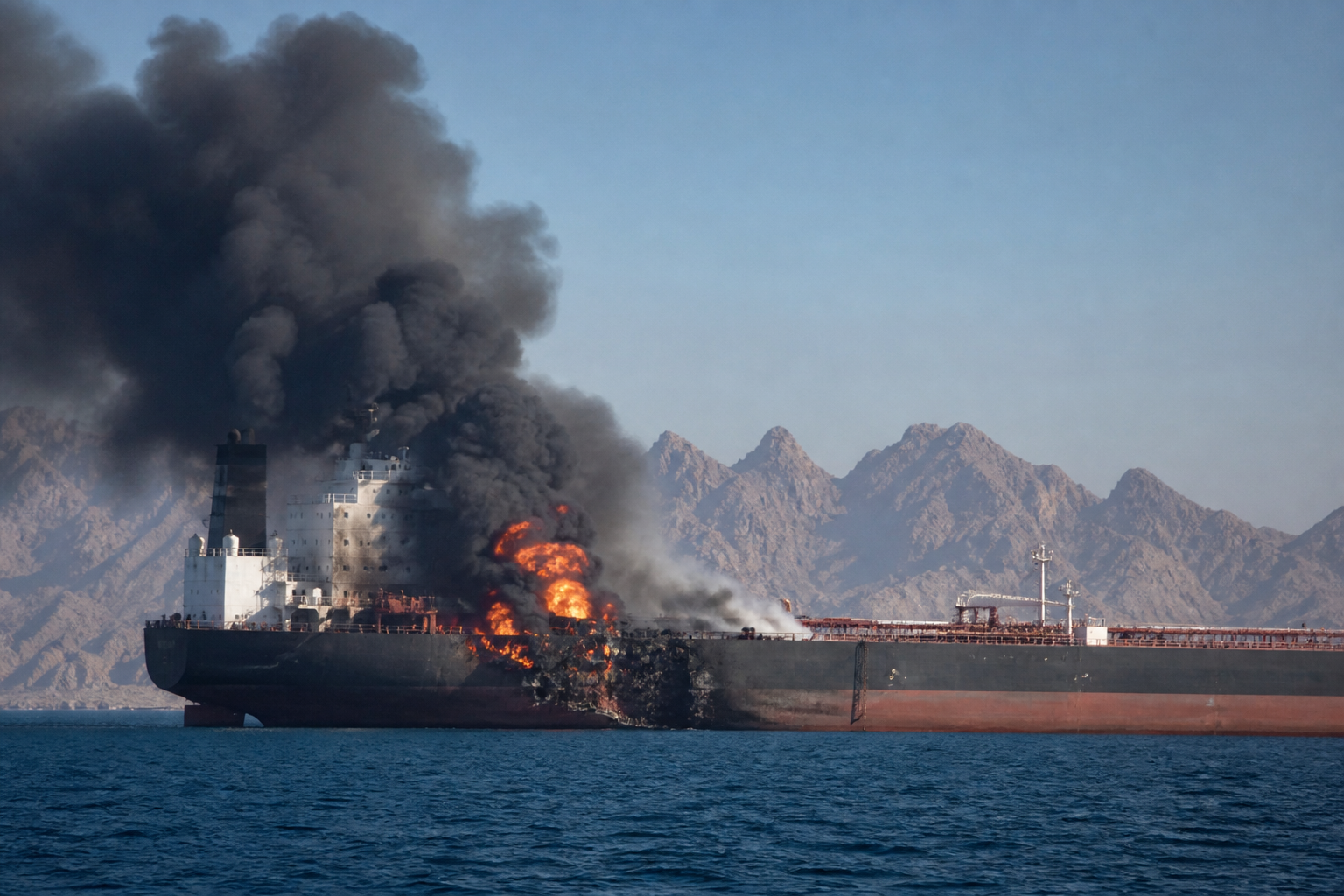
September 5–6, 2026. U.S. Central Command says American forces struck three Iranian-linked crude carriers after the Islamic Revolutionary Guard Corps launched ballistic missiles toward a U.S. aircraft carrier and a guided-missile destroyer. CENTCOM said both warships evaded the attacks and that no U.S. personnel were harmed. The response was deliberately economic as well as military: two tankers were rendered permanently unusable, while a third, the unladen M/T Kylo, was destroyed in the Gulf of Oman after its crew was told to abandon ship.
The vessels were identified as M/T Downy near Kharg Island, M/T Stark 1 near Jask and Kylo, also known as Noxen, farther east. CENTCOM commander Admiral Brad Cooper framed the operation as a warning to the IRGC that firing on American ships would bring a higher cost to Iran’s exposed oil network. The command said the carriers were part of a multibillion-dollar shadow system that finances the Guards and regional proxies. Tehran has condemned the strikes as illegal attacks on commercial shipping.
The military logic is straightforward but risky. Washington is trying to deter missile attacks without immediately widening the target set to ports, refineries or Iranian naval bases. Hitting ships linked to the revenue stream signals that the United States can reach the sanctions-evasion architecture that keeps oil moving. But tankers are also mobile commercial platforms. Even when a vessel is allegedly tied to a state network, attacks against it raise questions about warning procedures, legal authority and the danger of spills or miscalculation in crowded waters.
Kharg Island makes the message sharper. It is central to Iran’s crude-export system, so a strike nearby carries psychological weight beyond the loss of one hull. Jask and the Gulf of Oman extend that pressure toward the approaches to Hormuz, where shipping companies are already reassessing routes and insurance. The result is a new form of escalation in which the battlefield is not only a missile exchange but the infrastructure that converts oil into military capacity.
The next test is whether Tehran treats the operation as a bounded punishment or proof that its maritime network is under siege. If the IRGC attacks more commercial vessels, Washington will face pressure to expand protection and retaliation. If Iran pauses, CENTCOM may claim deterrence without a larger war. For now, three tankers have turned a failed missile salvo into an energy-security crisis, and the Strait of Hormuz is the place where that crisis will be measured.