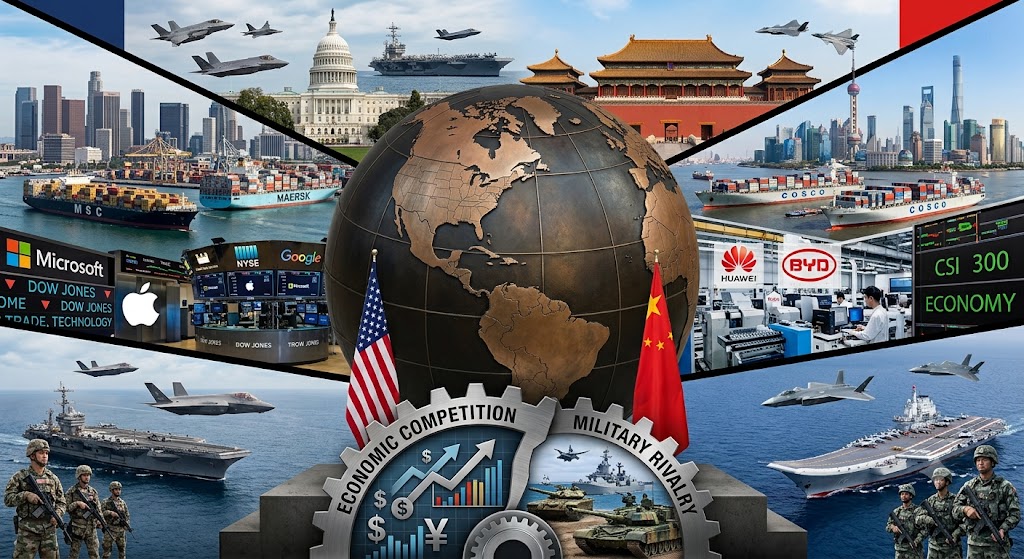
The website at uscc.gov serves as the official online home of the U.S.-China Economic and Security Review Commission (USCC), a bipartisan legislative branch body created by the U.S. Congress in October 2000. It provides policymakers, researchers, journalists, and the public with in-depth, authoritative analysis of the national security implications of the U.S.-China relationship, with a strong emphasis on China’s economic, technological, military, and geopolitical ambitions.
Mission and Mandate
The USCC’s core mandate is to monitor, investigate, and report to Congress on the national security implications of the bilateral trade and economic relationship between the United States and the People’s Republic of China. It submits an annual report with recommendations for legislative and administrative action. The commission fulfills this through public hearings, staff research, contracted studies, and ongoing analysis of emerging issues.This focus makes the USCC one of the most specialized and respected U.S. government sources on China. Its work bridges economics and security, examining how China’s industrial policies, technological advances, military modernization, and global influence operations affect American interests and the broader international order.What You’ll Find on the WebsiteThe site is professionally designed, well-organized, and highly navigable. Key sections include:
- About Us: Details on the commission’s charter, current commissioners (appointed on a bipartisan basis by congressional leadership), staff, job opportunities, and contact information.
- Annual Reports: A complete archive of yearly reports to Congress, going back to the early 2000s. These are the commission’s flagship publications.
- Research: Hundreds of staff-led papers, fact sheets, and analyses organized by topic. Categories cover China’s Economy and Resources, Security and Defense, Science and Technology, Trade and Supply Chains, Global Relations and Influence, Taiwan, Hong Kong, and more.
- Hearings: Transcripts and materials from public hearings featuring expert testimony from government officials, academics, industry leaders, and others.
- Recommendations: Compiled policy suggestions from the annual reports.
- China Bulletin: Periodic updates on timely developments.
- Featured Content: Quick resources like the “China 201” series of concise policy briefs, an AI Technology Stack Glossary for non-experts, fact sheets (e.g., on China-Iran relations), and analyses of specific issues such as Chinese companies listed on U.S. stock exchanges or PRC activities in international organizations.
The site includes robust search functionality, allowing users to filter by content type (reports, hearings, research). It also offers social media links, a mailing list for updates, and quick links to recent publications. Overall, it functions as a centralized, transparent repository of high-quality, policy-oriented information on China.
Spotlight: The 2025 Annual Report to Congress
One of the most significant resources available is the 2025 Annual Report to Congress, released in November 2025. This comprehensive document (hundreds of pages, drawing from multiple public hearings and expert testimony) examines China’s activities across economic, technological, military, and foreign policy domains.
Key themes in the 2025 report include:
- China’s Revisionist Ambitions: Analysis of Beijing’s efforts to remake the international order in ways that favor authoritarian governance and undermine U.S. leadership. This includes deepening ties with an “axis of autocracy” involving Russia, Iran, and North Korea—facilitating sanctions evasion, wartime logistics support, and mutual reinforcement of aggressive policies.
- Economic Distortions and “China Shock 2.0”: Discussion of China’s state-subsidized manufacturing overcapacity, massive trade surpluses, and export surges that distort global markets, threaten industries in the U.S. and allied nations, and create new dependencies.
- Supply Chain Weaponization and Technological Dominance: Examination of China’s control over critical minerals, pharmaceuticals, semiconductors, batteries, and other chokepoints, along with its “Made in China 2025” successes in areas like electric vehicles, robotics, and emerging technologies. The report also covers risks from cyberattacks and pre-positioning in critical infrastructure.
- Military and Security Developments: Updates on People’s Liberation Army (PLA) modernization, preparations related to Taiwan (including amphibious capabilities and gray-zone tactics in the South China Sea), space and counterspace ambitions, and broader efforts to achieve dominance in contested domains.
- Regional Influence: China’s strategies in Southeast Asia, the Pacific Islands, and elsewhere to expand economic leverage, military access, and authoritarian governance models.
The report includes dozens of recommendations to Congress, such as establishing a consolidated economic statecraft entity, strengthening supply chain resilience (especially in pharmaceuticals and energy), advancing U.S. leadership in critical technologies like quantum and biotechnology, and enhancing protections against coercion and sanctions evasion.
Full versions of the 2025 report and its executive summary are freely available as PDFs directly on the USCC website, along with previous years’ reports for historical context.Why USCC.gov Is an Excellent Source on ChinaThe USCC stands out as a reliable, non-partisan resource for several reasons:
- Bipartisan Credibility: Commissioners are appointed by both Democratic and Republican congressional leaders, ensuring balanced perspectives.
- Depth and Rigor: Reports are grounded in extensive research, public hearings with diverse experts, and data-driven analysis rather than speculation.
- Policy Relevance: The focus on actionable recommendations makes it particularly valuable for lawmakers, government agencies, and businesses navigating U.S.-China competition.
- Transparency and Accessibility: Nearly all materials—including full reports, hearing transcripts, and research papers—are publicly available at no cost.
- Timeliness: Regular updates via the China Bulletin and targeted research on fast-moving issues like AI, supply chains, and gray-zone tactics keep the content current.
In an era of complex U.S.-China strategic competition, the USCC provides clear-eyed assessments of China’s ambitions—its drive for technological and industrial supremacy, efforts to reshape global norms, and use of economic tools for geopolitical leverage—without hyperbole or political spin.ConclusionThe uscc.gov website is an indispensable hub for anyone seeking serious, evidence-based insights into China’s rise and its implications for the United States and the world. Whether you’re interested in the latest on supply chain risks, Taiwan contingencies, space competition, or broader revisionist ambitions, the site offers high-quality materials directly from a congressional commission tasked with informing U.S. policy.The 2025 Annual Report exemplifies this value, delivering a detailed roadmap of China’s strategic trajectory and concrete recommendations for how the U.S. can respond. For researchers, policymakers, or informed citizens, bookmarking uscc.gov is a smart move—it remains one of the best single sources for understanding the evolving U.S.-China relationship.