
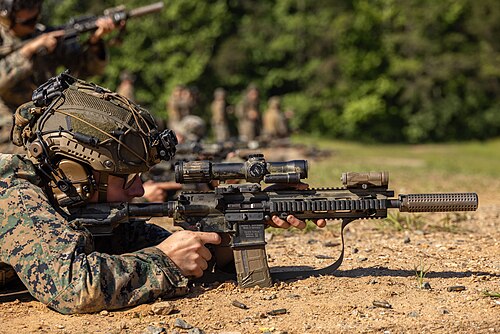
As of February 2026, the U.S. Marine Corps (USMC) has officially confirmed it will retain the Heckler & Koch M27 Infantry Automatic Rifle (IAR) as its standard-issue service rifle for close combat formations. It will also continue using the SIG Sauer M17 (full-size) and M18 (compact) pistols as primary sidearms. This decision bypasses the U.S. Army’s Next Generation Squad Weapon (NGSW) program weapons—the SIG Sauer M7 rifle and M250 light machine gun—chambered in the new 6.8x51mm hybrid cartridge. (taskandpurpose.com)
A USMC spokesperson stated: “The Marine Corps will retain the M27 for our close combat formations as it best aligns with our unique service requirements, amphibious doctrinal employment of weapons, and distinct modernization priorities, while ensuring seamless interoperability across the Joint force and with coalition partners.” The Corps will “continue to monitor development of the M7 to inform future requirements” and evaluates equipment against its “unique expeditionary requirements.” (taskandpurpose.com)
This report details each weapon’s history, specifications, positives, negatives, and the rationale behind the USMC’s choices.1. Heckler & Koch M27 Infantry Automatic Rifle (USMC Standard Rifle)The M27 is a select-fire, gas-operated short-stroke piston rifle derived from the civilian/military HK416 platform. It was developed specifically for the USMC’s Infantry Automatic Rifle (IAR) program to replace portions of the belt-fed M249 Squad Automatic Weapon (SAW). (en.wikipedia.org)
Key Specifications:
- Caliber: 5.56×45mm NATO
- Weight: ~7.9 lb (3.6 kg) empty; ~9.8 lb (4.4 kg) loaded
- Length: 33–36.9 in (adjustable stock)
- Barrel: 16.5 in
- Rate of fire: 700–900 rpm cyclic
- Effective range: 550 m point target
- Feed: 30-round STANAG magazines (PMAG compatible)
- Features: Free-floating barrel, Picatinny rails, ambidextrous controls, optics-ready (often with ACOG or VCOG)
Positives:
- Exceptional reliability in harsh environments (dust, sand, mud) due to the short-stroke piston system, which runs cooler and fouls less than the direct-impingement M4/M16.
- High accuracy (~2 MOA with free-floating barrel) — far superior to the M249 for precision fire.
- Lighter and more maneuverable than the M249 (~9.8 lb loaded vs. 22+ lb), improving infantry mobility.
- Consistent weapon across the entire squad (every rifleman has the same capable rifle), simplifying training and logistics.
- Excellent ergonomics, modularity, and suppressor compatibility.
- Proven in combat (Afghanistan 2011 onward).
- Full interoperability with existing 5.56mm NATO stocks, allies, and coalition partners.
Negatives:
- Magazine-fed design limits sustained suppressive fire compared to the belt-fed M249 (USMC retained some M249s for specific roles).
- Higher unit cost (~$1,300) than the M4 carbine.
- 5.56mm cartridge has reduced terminal performance and armor penetration at longer ranges compared to larger calibers like 6.8mm or 7.62mm.
Why the USMC Chose the M27: Initially selected in 2010 to replace the M249 in automatic rifleman roles for better accuracy, portability, and reduced collateral damage in counterinsurgency operations. In 2017–2018, the Commandant expanded it to the standard infantry rifle for all squad members (except some leaders), replacing most M4/M16A4 carbines. The decision prioritized precision firepower, squad-level consistency, and logistical simplicity over raw volume of fire. It perfectly suits the Marine Corps’ expeditionary and amphibious doctrine.
SIG Sauer M7 Rifle (Army NGSW — Bypassed by USMC)The M7 (formerly XM7) is a SIG MCX Spear variant selected by the Army under the NGSW program to replace the M4 carbine and M249. It fires the new 6.8x51mm hybrid cartridge (with a steel case head and brass body) designed for superior performance against modern body armor.Key Specifications (approximate, post-updates):
- Caliber: 6.8x51mm hybrid
- Weight: ~8.4 lb (3.8 kg) empty; lighter variants ~7.6 lb
- Magazine: 20-round (SR-25 pattern)
- Combat load example: 140 rounds (7 magazines) — significantly heavier per round than 5.56mm
Positives:
- Dramatically improved lethality, range, and armor penetration (intended “one-shot stop” capability against peer adversaries).
- Modern features: ambidextrous controls, suppressor-optimized gas system, integrated advanced optics compatibility.
- Weight reductions achieved through iterative improvements.
Negatives:
- Significantly heavier weapon and especially ammunition — soldiers carry ~70 fewer rounds and a heavier total load (~4 lb more ammo weight than M4 equivalent).
- New proprietary caliber breaks interoperability with NATO allies and existing 5.56mm logistics chains.
- Higher program and sustainment costs; requires entirely new ammunition production and supply infrastructure.
- Early testing raised concerns about heat buildup (especially suppressed), potential reliability/durability issues, and reduced magazine capacity affecting sustained engagements.
- Less ideal for highly mobile, light infantry operations.
Why the USMC Is Bypassing the M7: The heavier weight and reduced ammunition capacity conflict with Marine Corps priorities for expeditionary and amphibious operations, where mobility, lighter individual loads, and the ability to carry more rounds are critical. The 5.56mm M27 maintains full interoperability with Joint forces and coalition partners. The M27’s proven reliability and accuracy already meet USMC doctrinal needs without the logistical burden of a new caliber. The Corps explicitly cites alignment with “amphibious doctrinal employment of weapons” and “distinct modernization priorities.”
SIG Sauer M17 and M18 Pistols (USMC Primary Sidearms)The M17 (full-size) and M18 (compact) are variants of the SIG P320 striker-fired pistol, selected through the Army-led Modular Handgun System (MHS) competition. The USMC adopted the M18 as its standard sidearm starting in 2020, replacing the Beretta M9, M45A1, and other legacy pistols. (en.wikipedia.org)
Key Specifications:
- Caliber: 9×19mm Parabellum
- M17: Full-size frame, longer barrel/sight radius
- M18: Compact frame (preferred by USMC for versatility)
- Capacity: 17+1 (standard) or 21+1 (extended) magazines
- Features: Modular grip modules (for different hand sizes), optics-ready, night sights, ambidextrous controls, coyote-tan finish
Positives:
- Highly modular design allows customization.
- Excellent ergonomics and shootability compared to the M9.
- High reliability demonstrated in rigorous testing (e.g., M18 passed extended endurance tests with zero stoppages in key evaluations).
- High magazine capacity and good accuracy.
- Optics-ready and suppressor-compatible options.
- Joint-service commonality across the U.S. military.
Negatives:
- Some early P320 platform concerns (unintentional discharges) led to design fixes; military versions include additional safety features, though isolated incidents have prompted reviews.
- Heavier than some ultra-compact alternatives.
- Higher cost than legacy pistols (offset by performance gains).
Why the USMC Chose the M17/M18: The MHS competition selected SIG Sauer for best overall value, performance, and modularity. The USMC specifically chose the more compact M18 for better suitability across roles (including vehicle crews, aircrew, and infantry). It provides a modern, reliable upgrade over the aging M9 while enabling full interoperability with other U.S. services. Extensive testing confirmed superior durability and accuracy. (militarytimes.com)
ConclusionThe USMC’s decision reflects a deliberate focus on weapons systems optimized for its unique operational environment: expeditionary warfare, amphibious operations, and emphasis on mobility and interoperability over raw individual lethality. The battle-proven, lightweight, and logistically simple M27 in 5.56mm NATO provides an excellent balance of accuracy, reliability, and squad effectiveness. The M17/M18 pistols deliver modern ergonomics and commonality. By bypassing the heavier, more logistically demanding 6.8mm NGSW system, the Marines prioritize sustainment and maneuverability suited to their doctrine while monitoring future developments.This divergence highlights differing service priorities between the Army (heavy peer conflict emphasis) and the Marine Corps (light, agile, expeditionary focus). Both approaches aim to enhance warfighter effectiveness, but through different trade-offs in weight, firepower, and logistics.