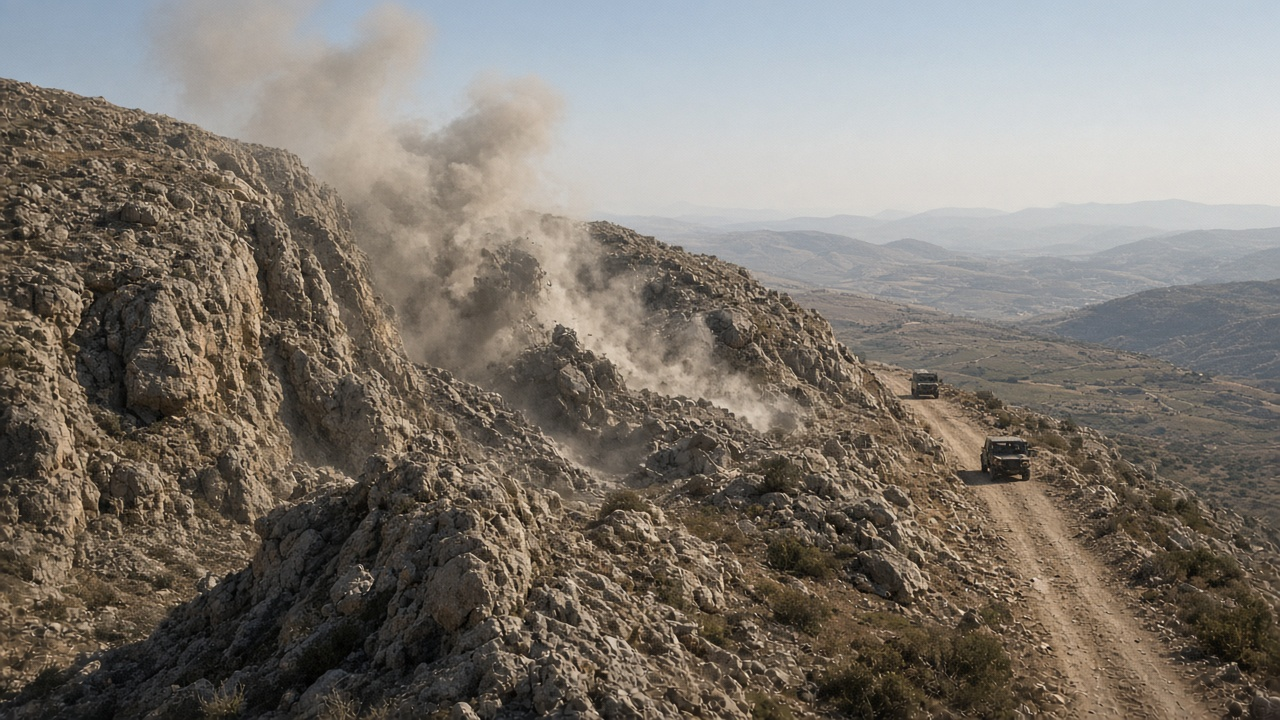
JERUSALEM — September 14, 2026. Israeli Defense Minister Israel Katz threatened Sunday to “eliminate” anyone approaching the Ali al-Taher ridge in southern Lebanon, saying the Israel Defense Forces were preparing to take lasting control of heights he cast as part of a self-declared “security zone” of roughly seven hundred square kilometers along what Israeli officials call the “yellow line.” Katz said Israeli forces had already killed Hezbollah fighters and destroyed tunnels there and would prevent the group—or any other party—from re-establishing a presence. He ruled out withdrawal or redeployment until Hezbollah is disarmed across Lebanon. Lebanese authorities and Hezbollah offered no immediate reply in initial regional reporting.
The warning followed Thursdays demolition of a Hezbollah tunnel-and-command complex on the ridge, an explosion so large the U.S. Geological Survey registered a 4.1-magnitude tremor. Prime Minister Benjamin Netanyahu had described the site as the “largest Iranian site outside Iran.” On Sunday, Lebanons state National News Agency reported fresh Israeli airstrikes and artillery across the Nabatieh belt—including Nabatieh al-Fawqa, Kfar Tebnit, the al-Dabsha hill approaches, and Zawtar al-Sharqiyah—without immediate casualty figures, according to Anadolu Agency. The ridge north of the Litani between Kfar Tibnit and Nabatieh al-Fawqa overlooks wide swaths of the south, which is why both sides treat it as more than a hilltop.
Strategically, Katz’s language hardens occupation into doctrine. A seven-hundred-square-kilometer zone held until nationwide Hezbollah disarmament is a political horizon, not a temporary raid—especially after Lebanese officials say nearly 4,400 people have been killed and 12,500 wounded in Israeli attacks since March 2. UN briefings in recent days have described a deteriorating Blue Line security picture even as Hezbollah projectile launches have been scarce since mid-June. For Tehran’s Lebanese proxy, losing Ali al-Taher’s underground architecture is a serious blow; for Israel, advertising a permanent kill zone on the ridge is an attempt to convert that blow into geography. The next test is whether Nabatieh-area fire stays punitive—or becomes the map.