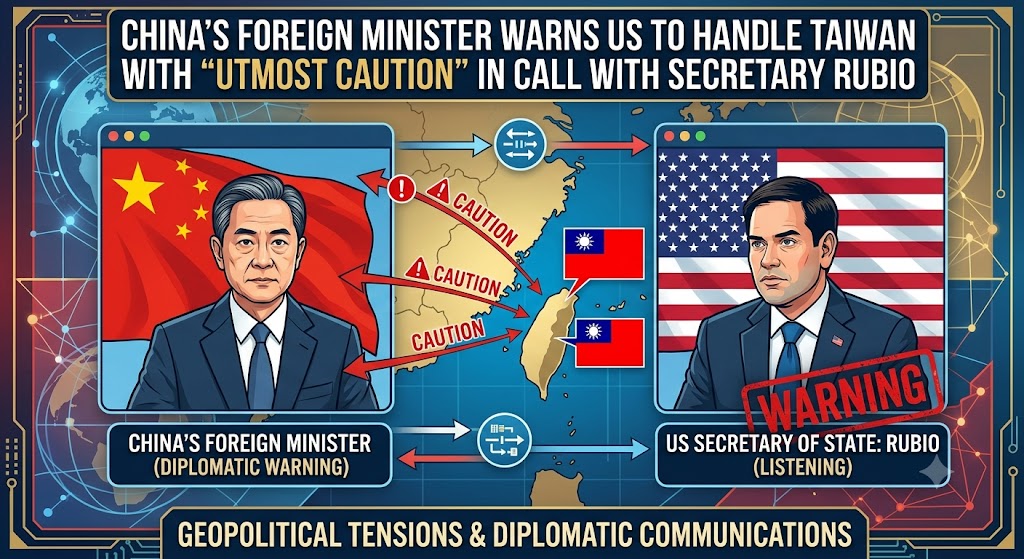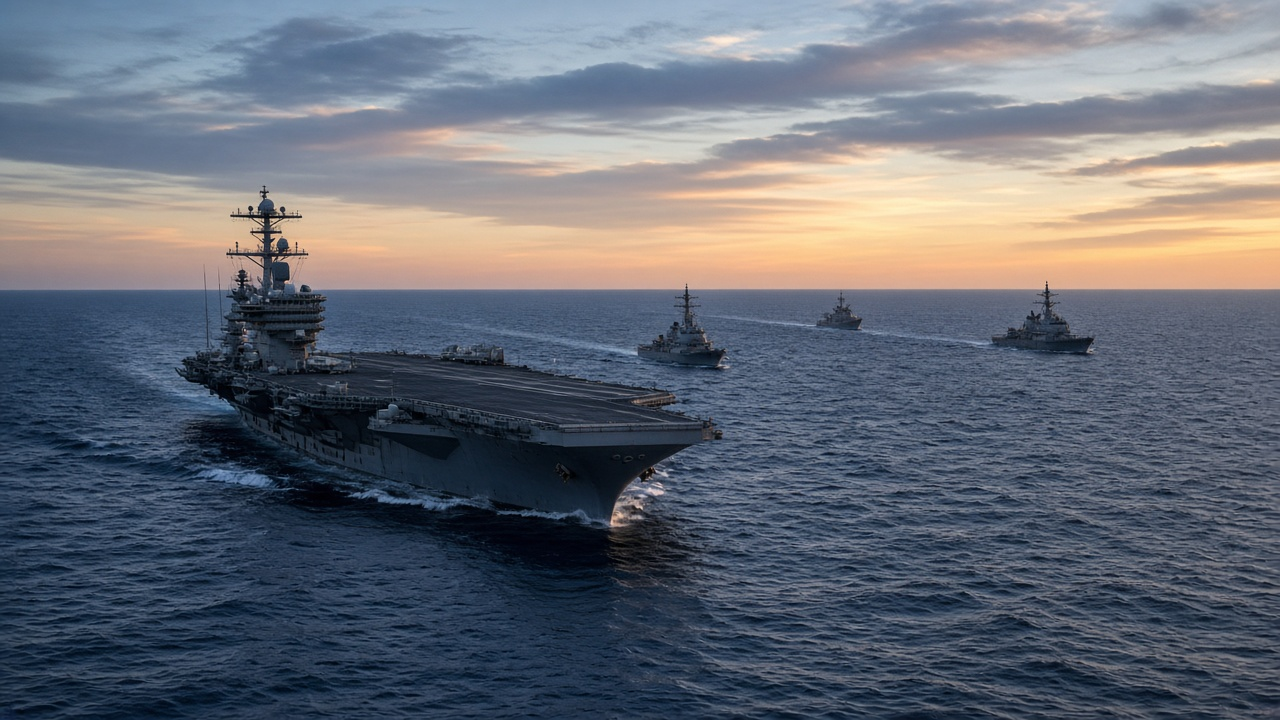
China is the Pentagon’s pacing challenge. Alliances, forward bases, and distributed forces are how Washington tries to deter a fight it does not want.
Geopolitics & Warfare · Why America Deploys · Part 1 of 12 — Indo-Pacific Overview
The United States keeps more combat power in the Indo-Pacific than in any other overseas theater for a blunt reason: Defense officials judge that China is the only competitor able to reshape the regional — and eventually global — military balance enough to break U.S. alliances and close off international waterways. That judgment has driven strategy documents since at least 2022, and it still frames how U.S. Indo-Pacific Command (USINDOPACOM) describes its job in 2025–2026 congressional testimony.
This series asks what the U.S. military is doing in each major theater, and why. Part 1 is the wide-angle map: the command, the allies that host it, the documents that justify it, and the posture themes linking Hawaii to Japan, Korea, Australia, and the Philippines. Later parts go deeper on Taiwan, then the South China Sea.
The priority theater — and what “pacing challenge” means
In the 2022 National Defense Strategy, the Department of Defense named China its “most consequential strategic competitor” and the “pacing challenge” for force design and war planning. The same strategy told the department to deter aggression while prioritizing the China problem in the Indo-Pacific, then the Russia problem in Europe — size the force for the hardest peer competitor first.
That framing formalized a shift already underway for more than a decade. CRS has noted that successive administrations treated competition with China as the organizing principle of Indo-Pacific posture — more personnel, new access arrangements, and concepts meant to survive long-range missiles rather than mass on a few large bases. CRS has also recorded that Defense planning treats a potential Taiwan Strait conflict as the “pacing scenario.”
A parallel White House document, the Indo-Pacific Strategy of the United States (February 2022), cast the same region in political language: a “free and open” Indo-Pacific where states make sovereign choices and shared seas and skies are governed by international law. The military piece is deterrence — making aggression look too costly — backed by alliances and forward presence.
Adm. Samuel J. Paparo, commander of USINDOPACOM, repeated the priority-theater line in April 2025 and April 2026 posture testimony. In 2026 he described deterrence by denial: a Western Pacific posture meant to make aggression infeasible, escalation unattractive, and conflict unbearable — while keeping options if deterrence fails.
What USINDOPACOM actually is
USINDOPACOM is a geographic combatant command headquartered near Honolulu. Its area of responsibility covers the Pacific and roughly half the Indian Ocean — about half the Earth’s surface by the command’s own description — and includes five mutual-defense treaty allies: Japan, South Korea, Australia, the Philippines, and Thailand.
CRS, in a March 2024 primer, put roughly 375,000 military and civilian personnel in the command’s area of responsibility. As of September 2023, most active-duty U.S. personnel assigned in the AOR were concentrated in Japan (about 53,000), Hawaii (about 45,000), South Korea (about 24,000), and Guam (about 6,400). The department operates or has access to more than 40 military sites across the region. Those figures are a snapshot of scale, not a live roster.
It integrates Army, Navy, Marine Corps, Air Force, and Space Force components, plus subordinates such as U.S. Forces Japan and U.S. Forces Korea — exercises, patrols, logistics, and crisis response day to day.
Posture themes: deter, distribute, ally, sail
Four themes dominate official Indo-Pacific posture language.
Deterrence. Paparo’s 2025 statement put the primary Indo-Pacific objective simply: deter China by prioritizing combat-credible forces west of the international date line — forces that can respond immediately, not only after a long surge from the continental United States.
Alliances as the asymmetric edge. Treaty allies give the United States geography it cannot buy: ports, airfields, training ranges, and political legitimacy. Paparo’s 2026 testimony called that network a “tremendous asymmetric advantage.” Japan and South Korea remain the high-end Northeast Asian hubs; Australia anchors the southern approaches; the Philippines sits astride key approaches to Taiwan and the South China Sea.
Freedom of navigation and a free and open region. U.S. policy treats excessive maritime claims as a challenge to commerce and law. Freedom of Navigation operations and routine presence are the operational expression of that policy — and a recurring friction point with Beijing in the South China Sea (Part 3).
Force distribution. China has built long-range systems designed to keep U.S. forces away from the First and Second Island Chains. The U.S. answer is dispersal: rotational access, agile logistics, and concepts such as Marine Expeditionary Advanced Base Operations, Air Force Agile Combat Employment, and Navy Distributed Maritime Operations — “places, not bases” rather than permanent large installations.
Congress has funded pieces of this agenda through the Pacific Deterrence Initiative, a budget display for Indo-Pacific readiness and posture. CRS cautions that PDI does not capture every dollar the theater needs.
Concrete moves readers can date
Strategy only matters if posture changes on the ground:
- January 11, 2023: At a U.S.–Japan “2+2,” Washington and Tokyo agreed to reorganize the 12th Marine Regiment on Okinawa into the 12th Marine Littoral Regiment, a smaller, more mobile formation for stand-in operations inside the First Island Chain, with redesignation planned by 2025 — framed as a capability shift, not a net troop increase on Okinawa.
- April 3, 2023: Manila named four additional Enhanced Defense Cooperation Agreement (EDCA) sites, bringing designated Philippine locations for rotational U.S. access to nine. Sites face Taiwan and South China Sea approaches. EDCA (2014) allows training, pre-positioned equipment, and infrastructure — not permanent bases of the pre-1992 Subic/Clark era. Paparo’s April 2026 testimony said the Defense Department had committed more than $300 million in EDCA infrastructure to date, including an additional $144 million for Fiscal Year 2026.
- AUKUS Pillar I (announced March 2023): Australia, the United Kingdom, and the United States set a pathway for Australia’s conventionally armed, nuclear-powered submarines. A near-term piece is Submarine Rotational Force–West at HMAS Stirling near Perth, planned as early as 2027, with increased U.S. submarine visits beforehand. Paparo’s April 2026 testimony said establishment work was proceeding under presidential direction to move “full steam ahead.”
- Rotations and exercises: Marine Rotational Force–Darwin and expanded bomber and fighter rotations deepen the Australian footprint. Paparo also cited major joint and combined exercises, closer U.S.–Japan command-and-control work as Tokyo stood up a Joint Operations Command, and Exercise Keen Edge in February 2026 as a bilateral milestone.
None of these moves alone “solves” the China problem. Together they show a pattern: push combat-credible mass west, multiply allied access points, and practice fighting as a coalition before a crisis starts.
What this theater is — and is not — for
The Indo-Pacific story is often flattened into a single Taiwan countdown. That is incomplete. USINDOPACOM also plans against North Korean nuclear and missile threats, watches a modernizing Russian Pacific Fleet, and manages maritime friction from the East China Sea to the South China Sea. China remains the pacing problem because its military modernization and coercive toolkit are the largest; it is not the only problem on the map.
It is also incomplete to treat U.S. presence as pure altruism or pure provocation. Official strategy says the purpose is deterrence and alliance defense. Critics argue the same forces raise tensions or lag China’s ship and missile output — Paparo has warned China is out-producing the United States in key air, maritime, and missile categories. Both points belong in an honest public brief.
So what
If you want to understand why American forces keep rotating through Yokosuka, Osan, Darwin, Guam, and Philippine EDCA sites, start here: U.S. strategy treats the Indo-Pacific as the priority theater because China is the pacing competitor, and because alliances on that map are the main tool to keep a regional war from becoming a global one. Presence is the visible half. Industrial capacity, munitions, and allied burden-sharing are the quieter half — and they will decide whether deterrence holds.
Next: Part 2 examines Taiwan and the First Island Chain — the pacing scenario behind much of today’s posture debate. Part 3 turns to the South China Sea, where law, trade routes, and daily coercion collide.