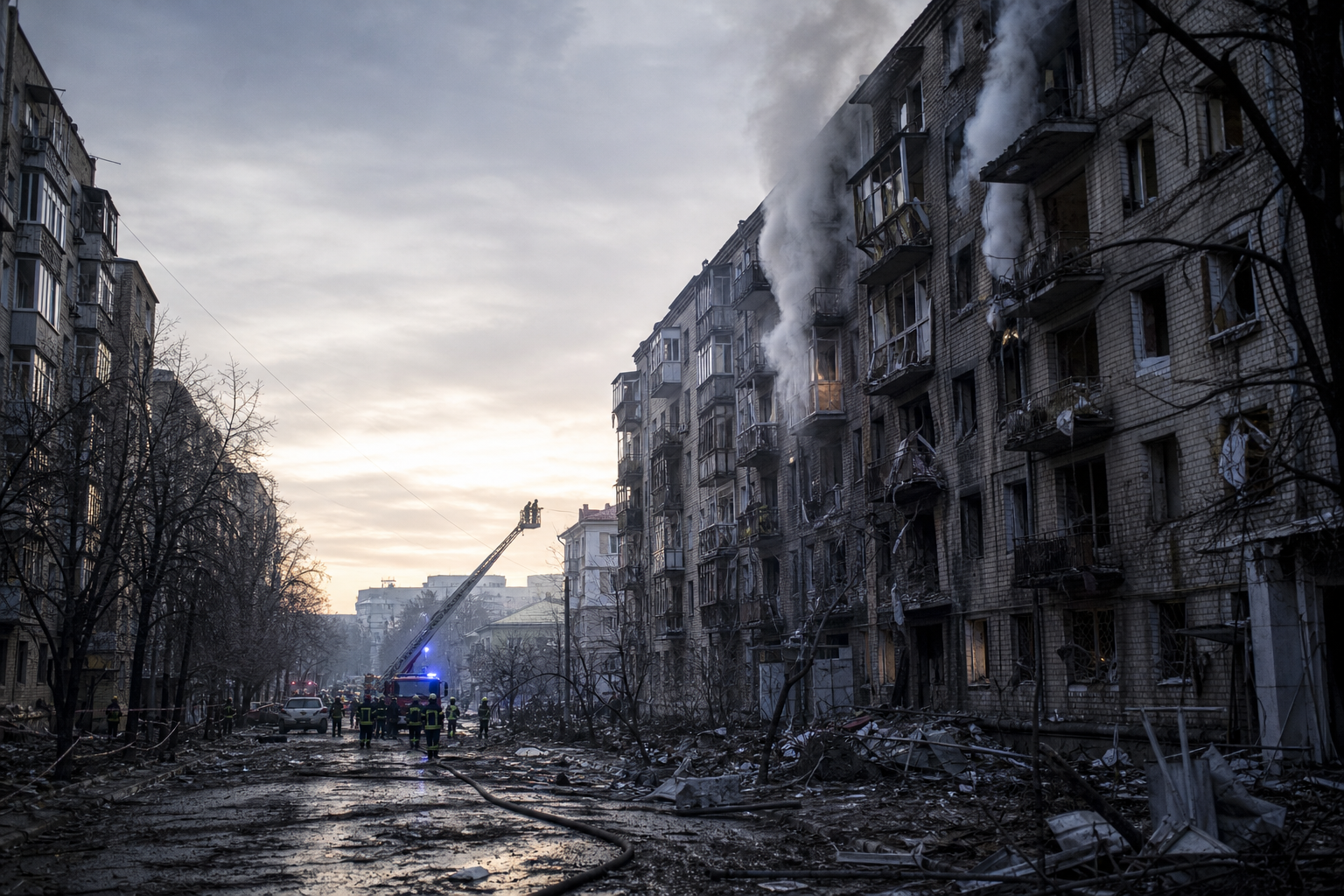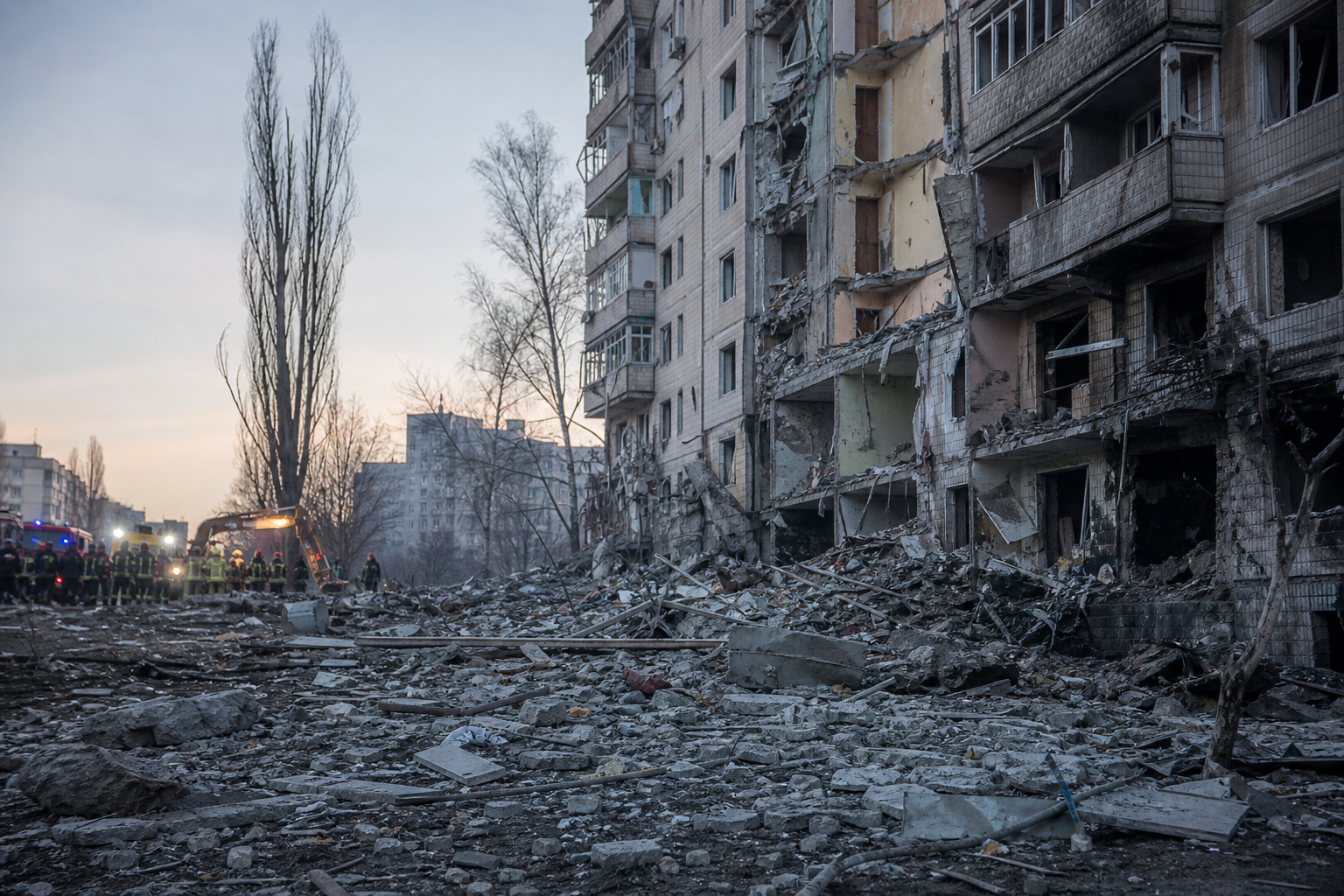
KYIV — September 16, 2026. Russia loosed a wave of roughly eighty Shahed-type and related attack drones overnight into September 16, Ukraine’s Air Force said, with air defenses downing or jamming sixty-three of them while impacts were recorded at seven locations — a smaller but still lethal package than the massive four-hundred-fifty-three-drone assault earlier in the week, and one that again reached the capital’s western districts and the country’s passenger rail network.
Ukrainian Air Force tallies overnight listed Shahed, Gerbera, and Parodiya-class systems in the mix, a combination designed to saturate radars with cheap decoys and force expensive interceptors into the wrong fights. Sixty-three killed or electronically suppressed still left enough leakers to start fires and scatter debris across multiple oblasts. Seven impact sites, even when most warheads fail, keep municipal emergency services on a war footing and remind civilians that “smaller than last time” is not the same as safe.
Kyiv Mayor Vitali Klitschko said debris from a downed drone damaged a warehouse in the capital’s Sviatoshynskyi district and injured one person — a familiar pattern in which successful intercepts still rain wreckage onto residential and light-industrial zones. City services treated the injury and sealed the site while air-raid protocols wound down after dawn. Klitschko’s updates have become a parallel battle-damage assessment for urban Ukrainians who trust municipal channels as much as national military briefings.
Separately, Ukrzaliznytsia reported that passenger train 122 on the Kyiv–Mykolaiv route was evacuated after the overnight threat environment made continued movement unsafe; the railway said there were no injuries among passengers or crew. The incident is distinct from the earlier Russian drone strike that hit the Kyiv–Warsaw service near Yahodyn on the Polish border. Hitting or forcing the stop of an internal southern passenger train spreads the intimidation effect beyond the western logistics corridor and into the Black Sea hinterland that feeds Mykolaiv and Odesa.
Ukrainian military spokespeople framed the eighty-drone package as part of Russia’s sustained pressure campaign rather than a one-off spectacular. After the mid-September mass wave that accompanied strikes on energy and industrial targets deeper inside Russia’s own rear, Moscow appears willing to keep nightly packages in the dozens to hundreds — enough to exhaust crews, consume missiles, and generate daily casualty and disruption headlines without always matching the peak sortie count.
Ukrainian officials continue to press partners for more electronic-warfare kits and cheaper interceptors precisely because Gerbera and Parodiya decoys make every Shahed expensive to kill with legacy stocks. The overnight sixty-three-of-eighty success rate looks strong on paper; it still implies roughly one in five drones reached or affected defended airspace enough to register as an impact or forced evacuation. That ratio, repeated nightly, is a strategy of attrition against both metal and morale.
The Kyiv–Mykolaiv evacuation also lands in a week when Ukrainian energy diplomacy — including President Volodymyr Zelenskyy’s rejection of an unbalanced energy-infrastructure truce — keeps Western attention on reciprocity. Passenger rail is soft infrastructure: it moves workers, soldiers on leave, and families. Forcing evacuations without mass casualties still taxes public confidence and generates the kind of imagery Russian planners value when larger missile salvos are husbanded for colder months.
As of morning briefings, Ukraine counted one injured in Sviatoshynskyi warehouse debris, seven locations hit, sixty-three drones defeated, and a southern passenger train emptied without bloodshed. The night was not the four-hundred-fifty-three-drone storm. It was another proof that Russia can keep Ukraine’s air-defense math ugly on ordinary midweek nights and that Kyiv’s railways remain part of the battlefield even when the missiles stay on the trucks.