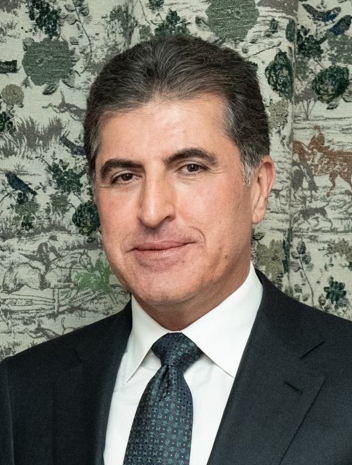
On July 3, 2026, Kurdistan Region President Nechirvan Barzani arrived in Tehran to participate in the state funeral ceremonies for Iran’s late Supreme Leader, Ayatollah Ali Khamenei. The visit, made at the formal invitation of Iranian President Masoud Pezeshkian, underscores the Kurdistan Regional Government’s (KRG) commitment to maintaining constructive relations with its powerful eastern neighbor amid a shifting regional landscape. (kurdistan24.net)
Khamenei, who had served as Supreme Leader since 1989, was killed on February 28, 2026, during joint U.S.-Israeli airstrikes targeting his compound in central Tehran as part of a major escalation in the Middle East conflict. His death marked a pivotal moment in Iranian and regional politics. The elaborate funeral proceedings, held at the Imam Khomeini Mosalla in Tehran, drew massive crowds—potentially 15–20 million mourners—and included numerous foreign dignitaries. Barzani joined a high-level delegation that also featured Iraqi President Nizar Amidi and Parliament Speaker Haibat al-Halbousi.
Details of the VisitBarzani’s participation went beyond symbolic attendance. He recited the Fatiha (a traditional Islamic prayer for the deceased) and engaged in high-level diplomatic meetings on the sidelines of the ceremonies. He met with President Pezeshkian, with additional meetings scheduled with Parliament Speaker Mohammad Bagher Ghalibaf and Foreign Minister Abbas Araghchi. (shafaq.com)
In a post on X following his meeting with Pezeshkian, Barzani stated:
“I am delighted to meet President @drpezeshkian in Tehran this morning. We discussed ways to further strengthen relations between the Kurdistan Region, Iraq, and Iran, with particular emphasis on expanding economic cooperation, and building on the historical, cultural, and neighborly ties that have long connected our peoples.”
The discussions focused on:
- Expanding bilateral trade and economic cooperation
- Enhancing border security and stability
- Preserving shared historical and cultural links between the Kurdish and Iranian peoples
- Hopes for lasting regional peace through renewed U.S.-Iran dialogue following the recent cessation of hostilities
Historical and Political Context
The Barzani family and the Kurdistan Democratic Party (KDP) have a long, complex history with Iran. Mustafa Barzani, Nechirvan’s grandfather and the founder of modern Kurdish nationalism in Iraq, maintained periods of cooperation with Tehran. Nechirvan Barzani himself has cultivated pragmatic diplomacy, balancing relations with Baghdad, Ankara, Washington, and Tehran.Iran remains a vital economic partner for the Kurdistan Region. Cross-border trade, energy projects, and shared security concerns (particularly regarding stability along the Iran-Iraq border) make constructive engagement essential. Barzani’s attendance reinforces this reality rather than signaling ideological alignment.What It MeansBarzani’s presence at Khamenei’s funeral carries several layers of significance:
- Pragmatic Diplomacy Over Ideology: In a region often defined by sectarian or ideological divides, Barzani’s move demonstrates a focus on national interests—economic opportunity, border security, and regional stability—rather than political posturing. It shows the KRG’s willingness to engage with Iran’s new leadership under President Pezeshkian during a sensitive transition period.
- Economic and Security Priorities: With the Kurdistan Region seeking to diversify its economy and attract investment, stronger ties with Iran offer practical benefits in trade, infrastructure, and energy. The meetings explicitly highlighted expanding economic cooperation.
- Contribution to De-escalation: By participating in the funeral and voicing support for dialogue (including U.S.-Iran engagement), Barzani positioned the KRG as a constructive actor advocating for reduced tensions. This aligns with broader regional efforts to consolidate a fragile ceasefire.
- Strategic Balancing Act: The visit occurs as Iran navigates a post-Khamenei era and the wider Middle East processes the aftermath of recent conflict. For the KRG, maintaining open channels with all neighbors—including Iran—is a core element of its “good neighbor” policy that has helped it navigate crises for years.
- Symbolic Continuity: The attendance honors longstanding people-to-people ties across the border while signaling that the Kurdistan Region seeks partnership and mutual respect, not confrontation.
In summary, Nechirvan Barzani’s attendance at Ayatollah Ali Khamenei’s funeral was not merely a protocol-driven gesture. It was a calculated diplomatic act reflecting the Kurdistan Region’s mature, interest-based foreign policy. In a volatile Middle East still processing the shock of Khamenei’s death and recent conflict, such engagement helps keep doors open for dialogue, trade, and stability—priorities that directly benefit the people of Kurdistan. As the region enters a new chapter, Barzani’s Tehran visit reinforces the principle that pragmatic diplomacy remains one of the most effective tools for small nations navigating great-power dynamics and neighborhood politics.