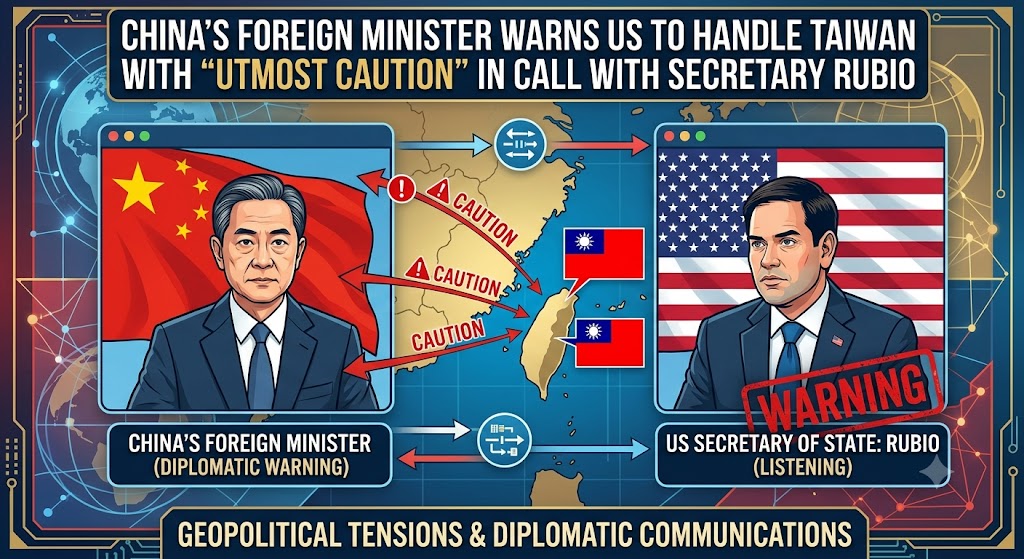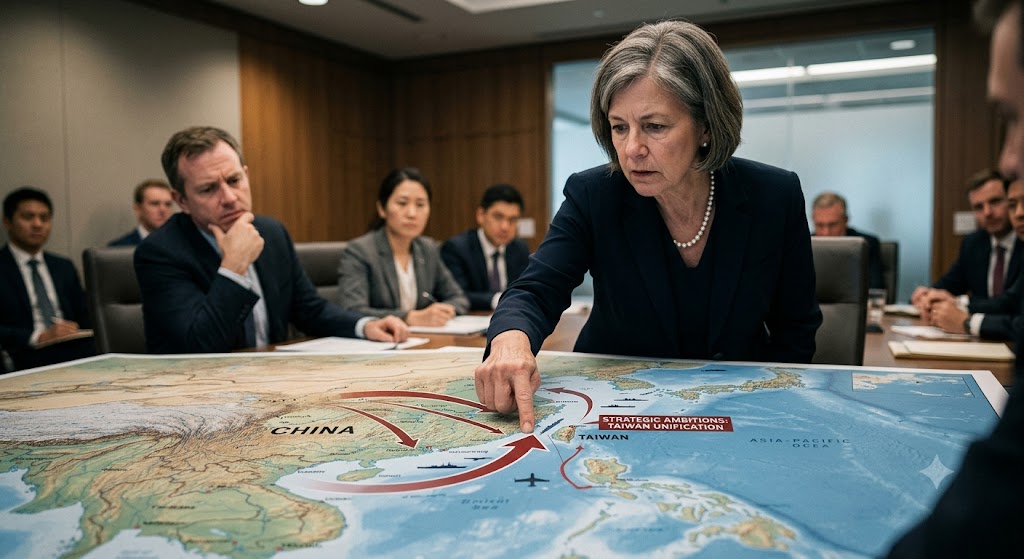
Executive SummaryThe People’s Republic of China (PRC) under the Chinese Communist Party (CCP) maintains a core strategic ambition: to achieve “reunification” with Taiwan (the Republic of China). Beijing views Taiwan as an inalienable part of China and a critical unfinished task of national rejuvenation and sovereignty. While Chinese leaders, particularly Xi Jinping, have long preferred peaceful unification, they have never renounced the use of force and have systematically built military capabilities and employed coercive tools short of war.As of 2026, U.S. intelligence assesses that China does not currently plan a full-scale invasion of Taiwan in 2027 (the so-called “Davidson Window”). Instead, Beijing is intensifying gray-zone coercion — military intimidation, economic pressure, disinformation, cyberattacks, and political influence operations — to erode Taiwan’s will to resist, normalize PRC presence around the island, and create conditions for eventual control without a high-risk amphibious invasion. (understandingwar.org)
The Institute for the Study of War (ISW), through its China & Taiwan portfolio (in partnership with AEI’s Coalition Defense of Taiwan project), continuously tracks these coercive campaigns, PLA exercises, and maritime activities as part of broader efforts to deter aggression and prepare for potential conflict.1. Historical and Ideological ContextTaiwan’s status stems from the Chinese Civil War (1945–1949). The defeated Republic of China government retreated to Taiwan in 1949, while the CCP established the PRC on the mainland. Beijing has never governed Taiwan but claims it as sovereign territory under the “One China” principle.For the CCP, control of Taiwan is:
- A matter of territorial integrity and ending the “century of humiliation.”
- Essential for securing the first island chain and projecting power into the western Pacific.
- A test of Xi Jinping’s legacy and the CCP’s ability to deliver on national rejuvenation by mid-century.
2. Xi Jinping’s Rhetoric and Stated AmbitionsXi Jinping has repeatedly and forcefully articulated the goal:
- Reunification is “unstoppable” and a historical inevitability.
- The Taiwan issue “should not be passed down to the next generation.”
- Peaceful unification is preferred, but force remains an option if necessary (consistent with the 2005 Anti-Secession Law).
These statements appear in major speeches, National Day addresses, and New Year messages. There is no public fixed deadline from Beijing, but U.S. intelligence (citing earlier statements) indicates Xi instructed the PLA to be ready for a successful invasion by 2027. Recent assessments suggest this is more a planning horizon than an imminent trigger.
understandingwar.org3. Military Capabilities and PreparationsChina has conducted the largest military modernization in the world, with Taiwan as the primary contingency. Key elements include:
- Massive expansion of ballistic and cruise missiles (including hypersonic systems like DF-17).
- Growth of the PLA Navy into the world’s largest by hull count, with advanced destroyers (e.g., Type 055) and growing amphibious lift.
- Focus on anti-access/area-denial (A2/AD) to deter or delay U.S. intervention.
- Regular large-scale joint exercises simulating blockades and amphibious assaults (e.g., the “Joint Sword” series).
Map of Taiwan and the Taiwan Strait — the ~100+ nautical mile body of water remains a major geographic barrier for any invasion.4. Gray-Zone Coercion Strategy (The Primary Approach in 2026)Rather than a single decisive invasion, China employs a sophisticated campaign below the threshold of war to achieve its goals:
- Military intimidation: Record numbers of PLA aircraft incursions into Taiwan’s Air Defense Identification Zone (ADIZ) — over 3,700 sorties in 2025 alone, continuing at high levels in 2026. Near-continuous naval and coast guard presence around Taiwan. First-ever military drone incursion into Taiwan’s territorial airspace (January 2026).
- Blockade/quarantine rehearsals: Repeated large-scale exercises simulating encirclement and disruption of maritime traffic.
- Economic coercion: Targeted sanctions, import bans, and pressure on Taiwanese businesses.
- Political and influence operations: Efforts to shape Taiwan’s 2026 local and 2028 presidential elections, disinformation campaigns (including AI-generated content), and recruitment of agents.
- Cyber and sabotage: cyberattacks on infrastructure and alleged undersea cable cuts.
- Lawfare and gray-zone maritime tactics: Using coast guard vessels for harassment and asserting jurisdiction.
These tactics aim to exhaust Taiwan’s resources, undermine public morale, and make resistance seem futile while avoiding direct U.S. military intervention.
brookings.edu5. Timelines and Invasion Scenarios
- 2027 Assessment: The U.S. Office of the Director of National Intelligence (ODNI) 2026 Annual Threat Assessment concluded that Chinese leaders “do not currently plan to execute an invasion of Taiwan in 2027” and have no fixed timeline for unification. They will continue setting conditions through coercion. understandingwar.org
- Possible pathways:
- Gradual coercion leading to political capitulation (preferred low-risk path).
- Blockade or quarantine to strangle the economy and force negotiations.
- Full amphibious invasion (highest risk, most difficult due to geography, Taiwanese resistance, and potential allied intervention).
Military purges in the PLA high command in recent years have likely complicated near-term invasion planning.6. Challenges and Risks for ChinaA full invasion would be extraordinarily costly and risky:
- Crossing the Taiwan Strait under fire is one of the most difficult military operations in modern history.
- Potential devastating economic sanctions and global supply-chain disruption (Taiwan produces the majority of advanced semiconductors).
- High probability of U.S. and allied (Japan, Australia, Philippines) military involvement.
- Significant PLA casualties and uncertain outcome.
These realities explain Beijing’s preference for sustained pressure over immediate kinetic action.7. Implications and Outlook
China’s ambitions toward Taiwan represent the most serious flashpoint in U.S.-China relations and a major threat to Indo-Pacific stability. Success for deterrence requires:
- Taiwan’s continued resilience and “porcupine” defense strategy (asymmetric capabilities + societal will).
- Credible U.S. and allied commitment (arms sales, training, forward presence).
- Economic and diplomatic measures to raise the costs of aggression.
ISW’s ongoing China & Taiwan updates provide detailed tracking of PLA activities, gray-zone operations, and cross-strait developments, supporting efforts to understand and counter Beijing’s campaign. (understandingwar.org)
Conclusion:
China’s determination to bring Taiwan under its control is unwavering and rooted in ideology, strategy, and national prestige. However, as of July 2026, the most likely near-term approach is intensified coercion rather than invasion. The situation remains fluid and dangerous; constant vigilance, strong deterrence, and clear communication are essential to prevent miscalculation that could lead to catastrophic conflict.This report draws primarily from ISW analysis, U.S. intelligence assessments (ODNI 2026), and open-source reporting on PRC activities. The situation evolves rapidly and should be monitored through primary sources such as ISW’s China & Taiwan updates.