Executive Summary
In October 2024, Israel’s Knesset passed two laws effectively banning or severely restricting the United Nations Relief and Works Agency for Palestine Refugees in the Near East (UNRWA) from operating in Israeli territory (including East Jerusalem) and prohibiting any contact between Israeli officials and the agency. The laws took effect in late January 2025.
Israel’s primary justifications center on national security: allegations that UNRWA staff participated in the October 7, 2023, Hamas attacks and that the agency has been infiltrated by Hamas, with its facilities used for military purposes. These concerns built on longstanding Israeli criticisms that UNRWA perpetuates the Palestinian refugee issue rather than resolving it.
UNRWA, the UN, and many international actors view the ban as a violation of international law, arguing it creates a humanitarian crisis by disrupting aid, education, and health services for millions of Palestinians. An October 2025 International Court of Justice (ICJ) advisory opinion found that Israel, as the occupying power, has an obligation to facilitate UNRWA’s humanitarian work and that the restrictions are unlawful. As of mid-2026, UNRWA continues limited operations in Gaza and the West Bank using local staff, but international staff access and direct aid imports remain blocked, severely constraining its work. (bbc.com)
Background: What is UNRWA?
UNRWA was established by the UN General Assembly in 1949 to provide temporary relief, education, healthcare, and social services to Palestinian refugees displaced by the 1948 Arab-Israeli war. It operates in Gaza, the West Bank (including East Jerusalem), Jordan, Lebanon, and Syria, serving approximately 5.9 million registered Palestine refugees. Unlike the UNHCR (which resettles or integrates other refugees), UNRWA uses a unique, hereditary definition of refugee status that passes to descendants. It has long been the primary provider of essential services in Gaza and parts of the West Bank. (en.wikipedia.org).
Longstanding Israeli Criticisms (Pre-2023)Israel has criticized UNRWA for decades, viewing it as an obstacle to peace:
- Perpetuation of refugee status: The hereditary refugee definition keeps millions registered indefinitely and promotes the “right of return” to Israel proper, which Israel sees as an existential demographic and security threat.
- Education and incitement: Israeli reviews and some international assessments have flagged anti-Israel or antisemitic content in UNRWA textbooks and teaching materials.
- Facility misuse: Israel has repeatedly accused militants (including Hamas) of using UNRWA schools, ambulances, warehouses, and compounds for military purposes in past conflicts (e.g., weapons found in schools during 2014 Gaza war; tunnels under facilities). israelpolicyforum.org
These issues made UNRWA politically toxic in Israel long before October 2023.3. The October 7, 2023 Trigger and Specific AllegationsFollowing Hamas’s October 7 attacks (which killed about 1,200 Israelis and took over 250 hostages), Israel escalated its campaign against UNRWA:
- Staff involvement in attacks: Israel alleged that 12 UNRWA Gaza staff participated directly in the attacks (including in killings, abductions, and logistics). A broader Israeli intelligence claim stated that hundreds (up to ~1,400 or ~10-12% of ~12,500 Gaza staff) were members of Hamas or Palestinian Islamic Jihad. govextra.gov.il
- Facility misuse: Israel claimed Hamas stored weapons in UNRWA schools, used compounds as command centers, and maintained tunnels under UNRWA headquarters in Gaza.
- Evidence and responses:
- UNRWA fired the 12 accused staff in January 2024.
- A UN internal investigation (August 2024) concluded that 9 staff “may have been involved” in the attacks and terminated them; evidence was insufficient for others.
- USAID’s Office of Inspector General independently confirmed links for some staff to the attacks and Hamas affiliation.
- UNRWA and independent reviews (e.g., Catherine Colonna report) stated there was no evidence of widespread or systemic militant infiltration. UNRWA maintains that the implicated staff represent a tiny fraction of its ~30,000+ global workforce. en.wikipedia.org
Prime Minister Netanyahu and Israeli officials stated that UNRWA workers involved in terrorism “must be held accountable” and that the agency could no longer be trusted. (bbc.com).
The 2024 Laws and Their Implementation
On October 28, 2024, the Knesset passed two bills with large majorities:
- Ban on operations in Israeli territory (92-10 vote): Prohibits UNRWA from operating in Israel, including East Jerusalem (e.g., shutting its headquarters and schools in areas like Shuafat).
- Severing ties (87-9 vote): Bars all contact between Israeli officials and UNRWA; cancels the 1967 Comay-Michelmore Agreement that facilitated UNRWA’s work in the occupied territories (visas, movement of staff/trucks, customs exemptions, security coordination). israelpolicyforum.org
The laws took effect ~90 days later (late January 2025). As of 2026:
- International UNRWA staff have been barred from entering the Occupied Palestinian Territory since early 2025.
- Since March 2025, Israel has blocked UNRWA from directly importing aid and personnel into Gaza.
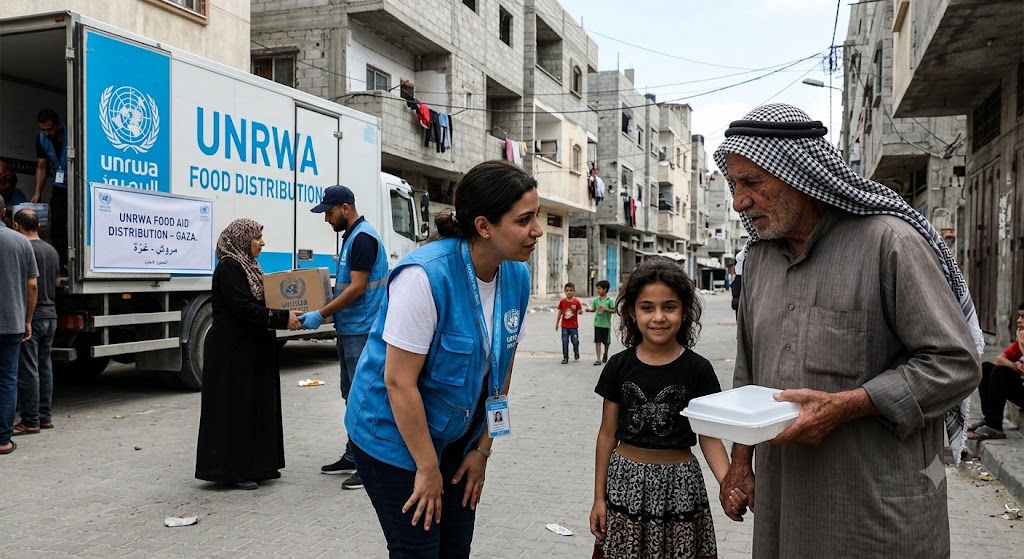
- UNRWA continues some operations in Gaza (health clinics, shelters for ~100,000+ people, WASH services, and limited/temporary education) using local Palestinian staff, but at greatly reduced capacity. Education has been especially disrupted. unrwa.org
5. Israel’s PositionIsrael argues the ban is a necessary security measure against an agency compromised by a terrorist organization (Hamas governs Gaza and is designated a terrorist group by Israel, the US, EU, and others). It claims UNRWA has lost neutrality and that continuing cooperation endangers Israelis. Israel has said it will work with other UN agencies and partners to deliver humanitarian aid without involving UNRWA. The move is also seen by supporters as ending an institution that institutionalizes perpetual refugeehood.6. UN, UNRWA, and International Position
- The UN and UNRWA describe the laws as an unprecedented attack on a UN agency and a violation of the 1946 Convention on the Privileges and Immunities of the United Nations (to which Israel is a party).
- They warn of catastrophic humanitarian consequences: UNRWA is the logistical backbone for aid in Gaza; without coordination, visas, and deconfliction, services for food, health, education, and shelter for millions collapse.
- UNRWA states it remains committed to operating and that only a minuscule number of staff were implicated.
- The October 2025 ICJ advisory opinion (requested by the UN General Assembly) ruled that Israel must facilitate UNRWA and other relief efforts, as it is the only feasible way to meet its obligations as occupying power to ensure the basic needs of the population. The Court found the ban and aid restrictions unlawful. ejiltalk.org
Many countries and organizations condemned the ban as disproportionate or politically motivated to undermine Palestinian institutions and the refugee issue.7. Humanitarian and Broader Impacts (as of 2026)
- Gaza: Severe constraints on aid delivery, education (hundreds of thousands of children affected), and health services. UNRWA shelters and local-staff operations continue but are limited.
- West Bank/East Jerusalem: UNRWA schools and services heavily restricted or closed in some areas.
- Overall: Heightened suffering for Palestinian civilians; increased pressure on other aid groups (some of which Israel has also restricted).
- No full replacement for UNRWA’s scale and local infrastructure has emerged.
Conclusion
Israel banned/restricted UNRWA primarily due to credible evidence of staff involvement in the October 7 attacks, broader Hamas infiltration of its workforce (per Israeli intelligence and some independent confirmations), and repeated misuse of its facilities—concerns amplified by pre-existing distrust over refugee policy and neutrality. Critics argue the response is disproportionate, legally flawed, and risks punishing millions of civilians for the actions of a small number of individuals while ignoring UNRWA’s essential humanitarian role. The situation remains highly contentious, with the ICJ having ruled against the restrictions and UNRWA adapting (imperfectly) with local staff amid ongoing operational bans. The ban reflects deep Israeli security fears rooted in specific incidents but has triggered widespread international concern over humanitarian access and international law. The long-term resolution will depend on security arrangements, political developments, and whether alternative aid mechanisms can fill the gap. This report is based on official statements, UN investigations, Israeli government claims, and reporting from multiple sources as of June 2026. The topic remains evolving and politically charged.