Russian Drones Breach Romania and Moldova Airspace During Ukraine Raid
Suspected Russian drones strayed into Romania and Moldova during a strike on Ukraine; one crashed near Solca and Gerbera wreckage was found in Florești.
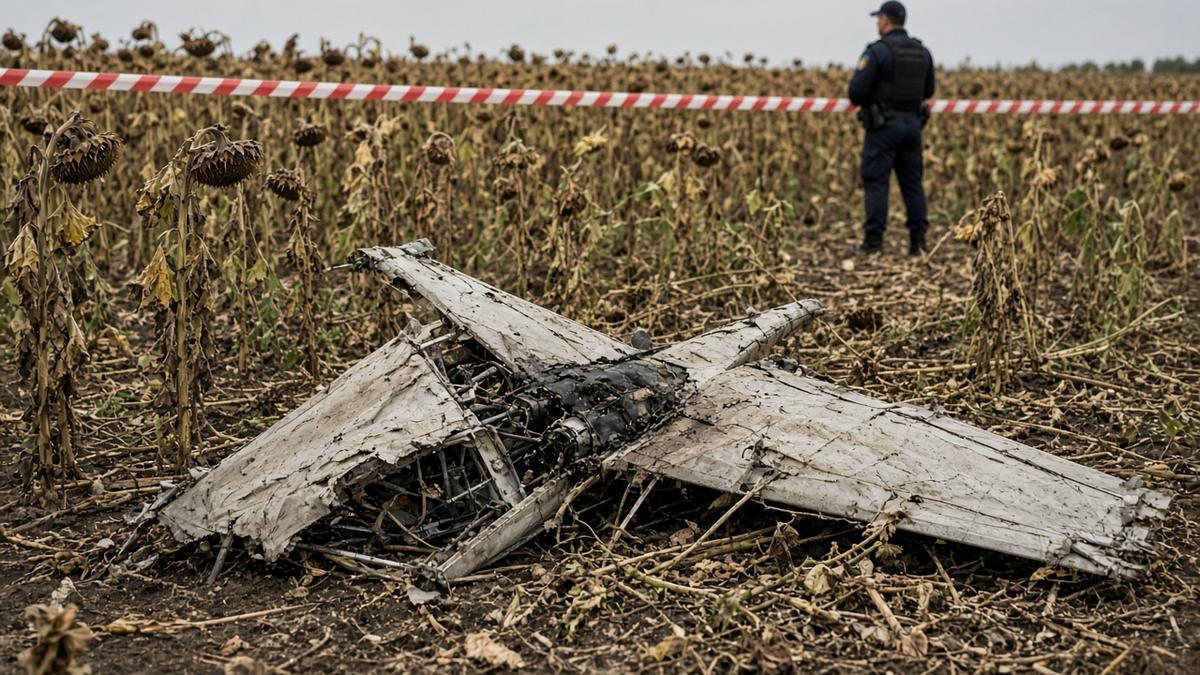
BUCHAREST / CHIȘINĂU — September 24, 2026. Suspected Russian drones spilled out of overnight strikes on Ukraine into two neighboring states, with Romania reporting a roughly four-minute airspace violation that ended in a crash near Solca and Moldova confirming four illegal overflights plus wreckage matching a Gerbera-type UAV in Florești district — the clearest same-night NATO-frontier spillover of the week.
Romania’s Ministry of National Defense said radar first tracked an aerial target over Ukrainian territory near the northern Botoșani border early Thursday, then watched it enter national airspace. The object flew about four minutes inside Romania before crashing near Solca in Suceava County without casualties or reported fire. Two Romanian F-16s scrambled to monitor and, if required, engage; authorities pushed a RO-Alert to Botoșani and Suceava residents and briefly disrupted local school schedules. Interior teams secured a small drone at the crash site. Acting Defense Minister Radu Miruța told local media a protest to Moscow was warranted even as Bucharest stopped short of an immediate formal attribution in its first bulletins.
Moldova’s night was denser. President Maia Sandu said four Russian drones violated Moldovan airspace during the mass attack on Ukraine and that at least one exploded in the north, declaring that Russia’s war endangers all of Europe. Parliament Speaker Igor Grosu called the overflights a direct sovereignty risk. Police later identified fragments near Cernita in Florești with “specific elements” of the Gerbera type used by Russian forces — described as the first such identification on Moldovan territory — and reported additional explosion reports toward Soldanesti and Camenca in the Transnistrian region. Authorities closed portions of northern airspace while investigations continued.
A Pattern of Airspace Incursions
The twin incidents fit a pattern rather than a one-off navigation error. A suspected Russian Shahed-type drone on September 8 nearly intersected President Zelenskyy’s aircraft departure from Moldova. On August 16 NATO fighters shot down a suspected Russian drone over Romania near the Moldovan border — the fourth Romanian case this year by Miruța’s count. On August 17 a Russian S8000 Banderol cruise missile crossed into Moldova during an Odesa strike and crashed in a cornfield near Talmaz. September 24 therefore adds Gerbera wreckage and a Solca crash to a dossier European capitals already cite when arguing that Ukraine’s air war is a continental air-policing problem.
NATO’s political problem is calibration. Romania is an Alliance member with F-16s and RO-Alert muscle memory; Moldova is not, sits next to Russian troops in Transnistria, and must condemn without overmatching. Both governments reported no deaths on September 24, which lowers the immediate Article 5 temperature but does not erase the precedent of debris fields and camera-equipped decoy drones landing on EU and candidate-state soil. Kyiv will use the spillover to argue for denser western AD coverage along the Danube and Dniester corridors; Moscow will call stray drones accidents of a war it refuses to pause.
Until Russia’s mass-drone nights stop producing foreign crash sites, Bucharest’s protest note and Chișinău’s Gerbera photos will keep arriving in the same overnight packages as Ukrainian casualty lists. September 24 made that linkage literal: one raid, three countries’ airspace narratives.
Sources
- Kyiv Independent: Suspected Russian drones crash in Romania, Moldova
- IPN: After the explosion in Florești, components of a drone similar to the “Gerbera” model were found
- Defence24: Drone crashed in Romania and Moldova