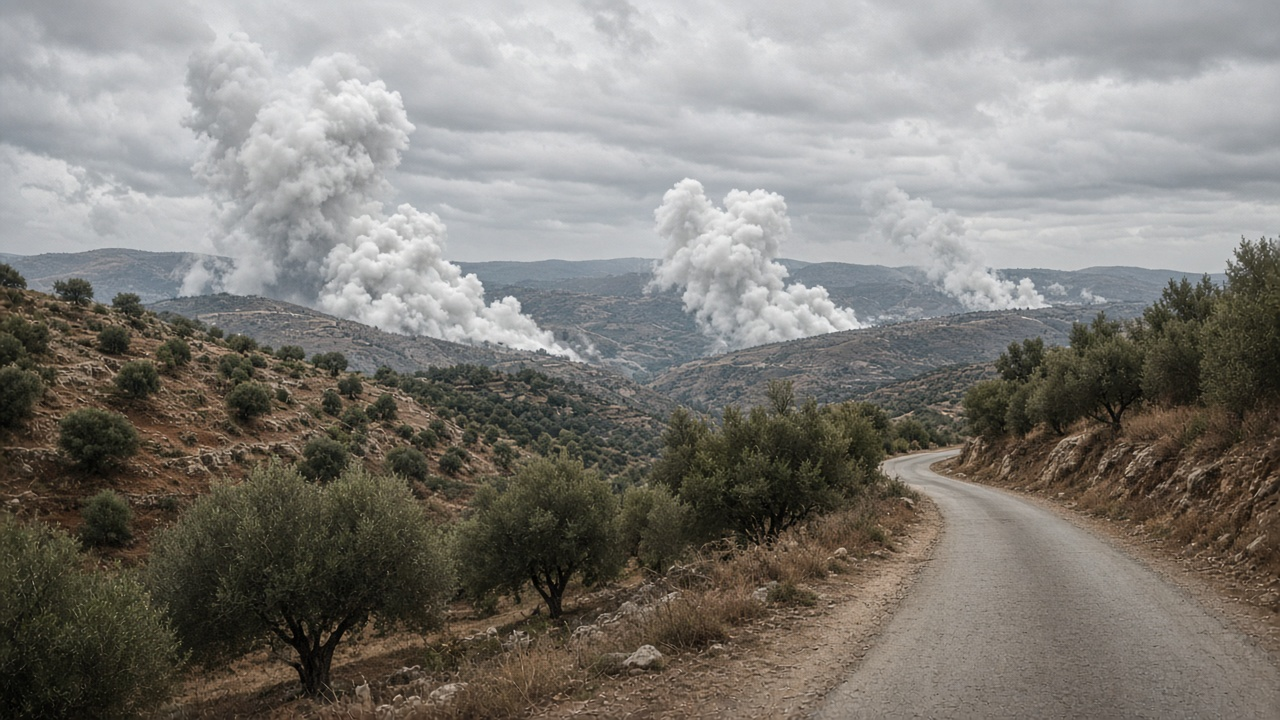
BEIRUT / TYRE — September 21, 2026. Israeli forces fired phosphorus munitions that sparked fires in olive and citrus orchards at Majdal Zoun and Buyout al-Sayyad in the Tyre district, Lebanon’s National News Agency reported via Anadolu Agency, while artillery and airstrikes continued across Tyre, Nabatieh, Bint Jbeil and Marjayoun — and three Merkava tanks advanced toward Deir Mimas, blocked the town entrance, searched homes and damaged telephone poles in an operation that undercuts the June 26 U.S.-brokered Framework meant to sequence Israeli withdrawal, Lebanese Armed Forces deployment and Hezbollah disarmament.
NNA’s September 21 account, carried by Anadolu, also listed shelling in Khiam, Wadi al-Salouqi and Wadi al-Hujeir, a stun grenade incident in Zawtar and a child injured by leftover munition in Debaal. Those details describe a southern belt still living under fire months after diplomats announced a framework for gradual de-escalation. Phosphorus use in orchard country is not only a tactical choice; it is a livelihood strike on trees that take years to replace, amplifying displacement pressure in communities already counting costs since the wider round of fighting intensified.
The Merkava advance on Deir Mimas sharpens the gap between paper and ground. Blocking an entrance, searching homes and cutting communications infrastructure are occupation-adjacent tactics inside a zone Israel has treated as a security depth rather than a temporary raid. Israel has advanced roughly twelve kilometers in places and maintains a Yellow Line security zone. The June 26 Framework envisioned Lebanese army deployment into vacated ground and a path toward Hezbollah’s disarmament; continued tank probes and orchard fires tell southern residents the sequence has stalled on the first step. This account stays distinct from earlier analysis of Hezbollah’s shift toward guerrilla methods: the September 21 facts are about Israeli fires, armor and shelling under a framework that has not produced quiet.
Casualty and displacement tallies remain contested and should be handled carefully. Lebanese authorities have cited thousands killed, injured or displaced since March 2; secondary figures circulated by outlets such as Yenisafak should be attributed as such and not treated as independently verified census data. What can be said with clearer sourcing is the geographic pattern NNA described: Tyre’s agricultural villages burning, Nabatieh and Bint Jbeil under fire, Marjayoun and the wadis shelled, and armor at Deir Mimas’ door. That pattern is enough to judge the Framework’s performance without inflating unverified person counts.
For Beirut, the politics are brutal. The Lebanese Armed Forces lack the capacity and political cover to disarm Hezbollah on a timeline Israel finds acceptable while Israeli armor still sits kilometers inside the south. For Jerusalem, continued pressure is framed as necessary so long as Hezbollah retains rockets and fighters north of the Blue Line. For Washington, the Framework’s authors, each week of phosphorus smoke and Merkava tracks is a reputational drain on a deal sold as an off-ramp. Hezbollah, for its part, can point to orchard fires and home searches as proof that restraint is not reciprocated — useful propaganda even when its own arsenal remains the Israeli casus belli.
What Majdal Zoun’s burning groves and Deir Mimas’ blocked entrance measure is framework failure in slow motion. Gradual withdrawal without verified LAF control becomes indefinite presence. Disarmament talk without quiet becomes a talking point. Until tanks pull back, fires stop and a monitored deployment sequence begins, southern Lebanon will keep trading olive smoke for security-zone logic — and the June 26 text will read more like an unread annex than a governing ceasefire plan.