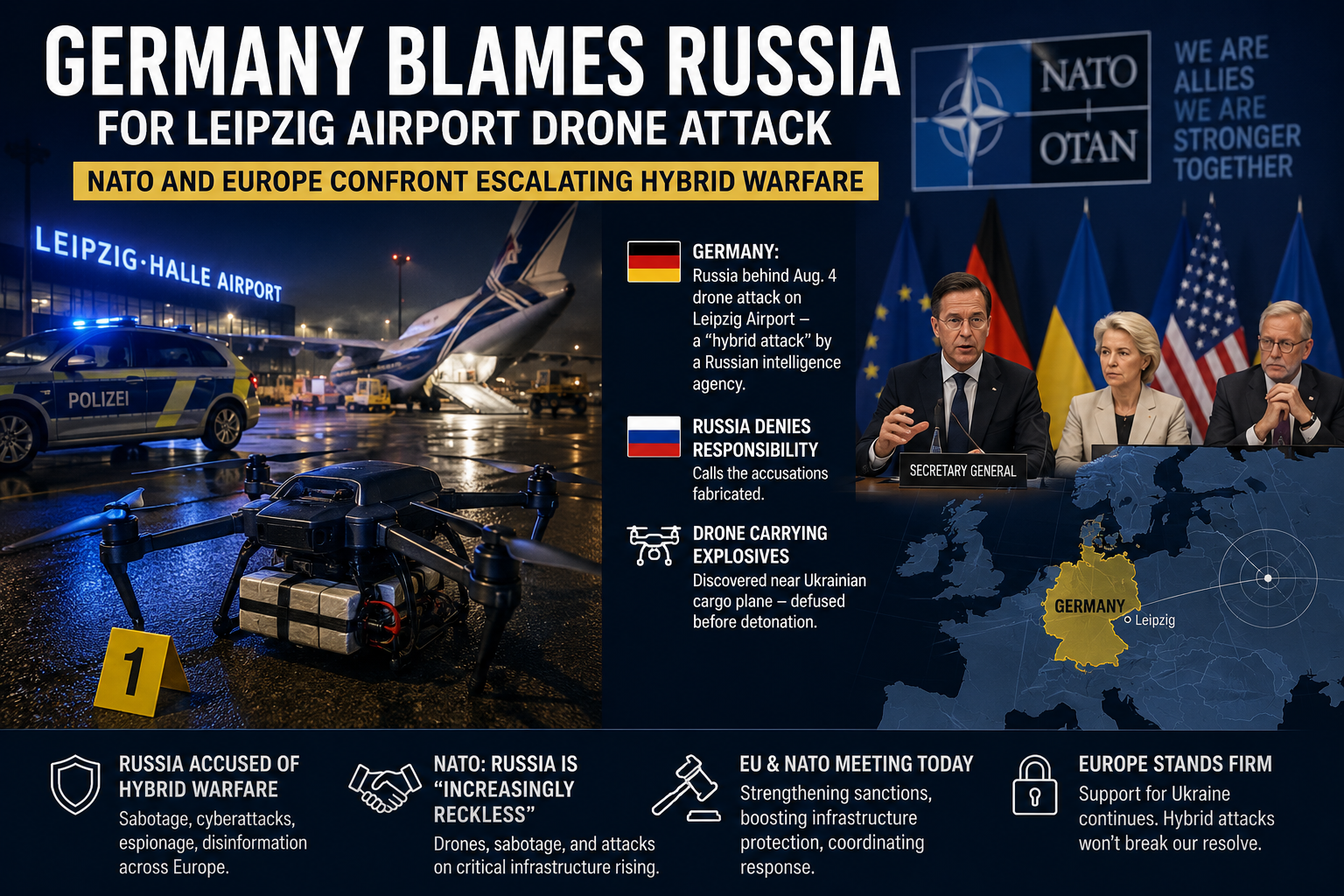
Germany has formally accused Russia of orchestrating an attempted explosive-drone attack at Leipzig/Halle Airport on August 4, marking a significant escalation in Berlin’s confrontation with Moscow. German authorities say intelligence assessments, police investigations and similarities to previous Russian operations point to Russian state involvement. The drone, which was carrying explosives, was discovered near a Ukrainian cargo aircraft and was successfully defused before it could cause a major attack.
German Interior Minister Alexander Dobrindt described the incident as part of a broader pattern of Russian hybrid operations against Europe, involving sabotage, cyberattacks, espionage and other covert activities. Berlin has responded by summoning Russia’s ambassador, moving to close Russia’s consulate in Bonn and taking additional measures against Russian-linked institutions. Germany also plans to push for additional European sanctions and tighter restrictions targeting Russian activities.
Russia has denied responsibility, with President Vladimir Putin dismissing Germany’s evidence as fabricated and warning that Berlin’s response could have consequences. Moscow’s rejection means the accusation is likely to become another major point of confrontation between Russia and Germany.
NATO Warns Russia Is Becoming “Increasingly Reckless”
The Leipzig incident is receiving particular attention in Brussels today as European officials discuss the growing threat posed by Russian hybrid warfare. NATO Secretary General Mark Rutte warned that Russia has become increasingly reckless, pointing to drones and missiles crossing European airspace as well as suspected Russian sabotage operations targeting facilities and infrastructure supporting Ukraine.
Rutte specifically cited the Leipzig incident as an example of the growing threat, saying NATO has seen an increase in hostile activities directed against European territory.
European Commission President Ursula von der Leyen has also condemned the attempted attack, arguing that Russian actions will not deter European support for Ukraine. NATO and EU officials are emphasizing that hybrid attacks are designed not only to damage infrastructure but also to intimidate European governments and weaken public support for Ukraine.
Why Leipzig Matters
The airport incident is significant because Leipzig/Halle is an important European cargo hub and has been used for transportation connected to Ukraine. A successful explosion near a Ukrainian transport aircraft could have caused casualties, destroyed valuable equipment and demonstrated that Russia—or an organization acting on its behalf—could strike a sensitive target deep inside Germany.
For Berlin, the incident also fits into a larger pattern. Germany and other European governments have increasingly accused Russia of conducting “hybrid warfare” designed to remain below the threshold of conventional military conflict.
The strategy can include cyberattacks, sabotage, arson, espionage, disinformation, GPS interference and attacks against critical infrastructure. The objective is often to create disruption and fear while making it difficult for governments to respond with conventional military force.
Europe Faces a Difficult Choice
The challenge for NATO and the EU is determining how aggressively to respond without allowing covert attacks to trigger a direct military confrontation with Russia.
European governments are discussing additional sanctions, diplomatic expulsions, intelligence cooperation and stronger protection for critical infrastructure. France has already expressed support for Germany’s proposed response and additional measures targeting Russia’s so-called shadow fleet.
For NATO, the central issue is deterrence. If Russia believes it can conduct sabotage or covert attacks against NATO countries without facing significant consequences, European officials fear that such operations could become more frequent.
At the same time, NATO must distinguish between hybrid attacks and an armed attack triggering Article 5. NATO has not indicated that the Leipzig incident constitutes an Article 5 situation. Germany has also chosen diplomatic and economic retaliation rather than requesting collective military action.
The Bigger Picture
The Leipzig incident comes at a particularly sensitive moment for European security. The war in Ukraine has increasingly spilled into the broader European security environment, with NATO countries reporting drone incursions, cyberattacks and suspected sabotage.
Germany’s decision to publicly attribute the Leipzig operation to Russian state actors represents a tougher stance from Berlin. Today’s discussions involving NATO and European leaders therefore extend beyond a single airport incident: they concern whether Europe is already facing a sustained Russian hybrid campaign—and how far Moscow is prepared to go to undermine European support for Ukraine.
With tensions rising, the message coming from Brussels today is increasingly clear: European governments intend to strengthen their defenses against Russian covert operations while continuing to support Ukraine.